The share of renters who had difficulty paying for housing jumped in 2025 and was concentrated among middle-income tenants, according to research from the Urban Institute released today. Tenants are increasingly struggling to afford both rent and utilities, as costs for essentials rise and U.S. households spend a growing share of their income on housing.
Overall, one in five renter households either paid rent late or missed a payment in 2025 — up from 16.5% in 2024 — marking the highest-ever percentage since the researchers began tracking the measure in 2017.
The lowest-income households continued to have the most difficulty paying rent, but “what was surprising is that the group with the largest change year to year was middle-income households,” according to Kathryn Reynolds, principal policy associate with the Research to Action Lab at the Urban Institute, where she focuses on affordable rental housing.
“We worry about the fact that rental insecurity is creeping into these higher income levels, because it's going to have downward pressure on the people that are most vulnerable in the rental market,” Reynolds told Multifamily Dive.
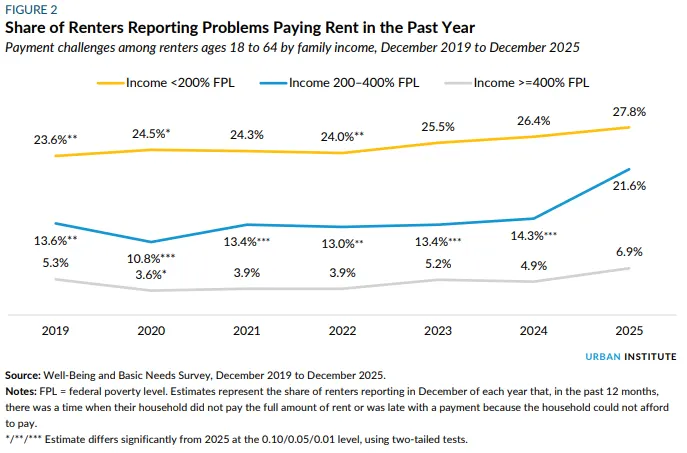
Reynolds and her fellow researchers Michael Karpman, Grace Koch and Samantha Batko examined trends in the share of working-age adult renters and homeowners who had difficulty paying for housing and utilities from 2019 through 2025.
The researchers found that the share of middle-income tenants — those with incomes between 200% and 400% of the federal poverty line — who reported rent affordability challenges rose sharply from 14.3% in 2024 to 21.6% in 2025. At the same time, nearly 28% of low-income households reported difficulty paying rent last year.
“This makes us concerned, because you have to think of the housing market as one ecosystem,” Reynolds said. If middle-income households, which typically have more buying power and choice in the rental market, are facing rental insecurity, “they're likely going to be competing for units that would otherwise be affordable and available to those lower-income households.”
The study also found that 20.7% of renters reported being unable to pay the full amount of their heating and electricity bills in 2025 — a share similar to 2023 and 2024, but higher than the 2019 through 2022 period.
Fewer adults reported problems paying utility bills between 2020 and 2022, the study showed, which may have been due to the strong federal COVID-19 response, including economic stimulus payments and safety net expansions.
Now, the growing difficulties in paying rent and utilities “reflect a larger, interconnected affordability challenge” in the U.S., according to the researchers.
Macroeconomic issues
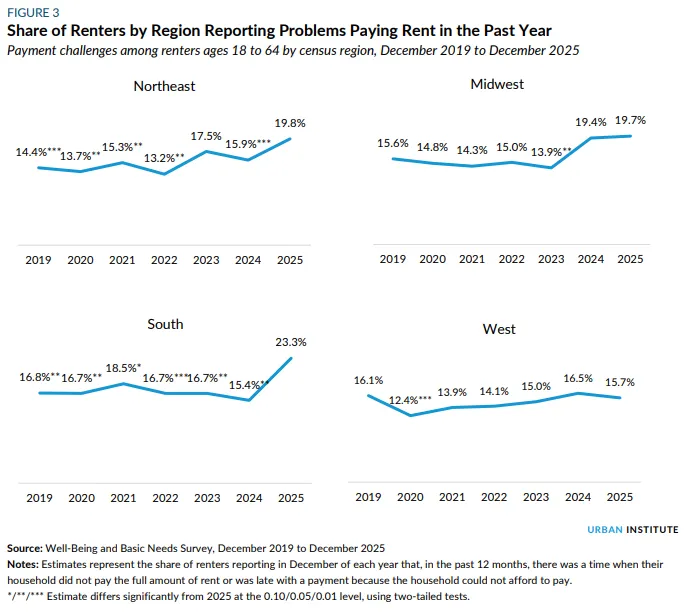
The share of renters with difficulty paying rent was higher in 2025 than in previous years in the Northeast, Midwest and South census regions, per the study, although it ticked down in the West.
The West was interesting because it’s “the only region without significant increases in difficulty paying rent,” Reynolds said. “Maybe it's a little bit of capturing that idea that some of the Sun Belt places are still relatively affordable compared to other parts of the country.”
Because the costs straining household budgets are interconnected, addressing affordability requires a range of solutions, “including policy levers at all levels of government, to directly promote affordability and stability and support renters and homeowners,” according to the study.
However, Trump administration efforts to expand work requirements and time limits for HUD housing “could reduce access to rental assistance for a portion of the 5 million renter households” that receive federal support, per the study.
Given the need to rein in price inflation amid broad affordability pressures like high gas and food prices, improving housing stability is “a really tricky problem” to address, according to Reynolds.
Besides getting inflation under control, “we also need to be building housing where it's needed and at the price points that it's needed,” Reynolds said. However, “another unfortunate outcome of inflation is that the cost to borrow has also increased, so the amount of subsidy needed for each unit of affordable housing is only increasing at a time when we need more and more units to meet people's needs.”
Reynolds suggested that apartment owners have an open dialogue with tenants facing payment difficulties, and be “as flexible as possible, within the financial restraints of the property.”
“I think at this moment folks are going to have to be a little bit creative, given that we're seeing even middle-income folks starting to struggle, and you want to be able to collect as much rent as you can, and avoid having to turn over units, which can be really costly,” Reynolds said.
On the policy side, localities and states should try to keep pushing developers to build, by subsidizing borrowing costs or providing extra subsidies, according to Reynolds. To that end, she said “there's a lot of promise in the ROAD to Housing” law.
“The devil’s in the details, but I do think that there could be some really interesting kind of new ways, new technologies, new ways that we can get homes built and sort of meet this from a supply side intervention,” Reynolds said.
Click here to sign up to receive multifamily and apartment news like this article in your inbox every weekday.