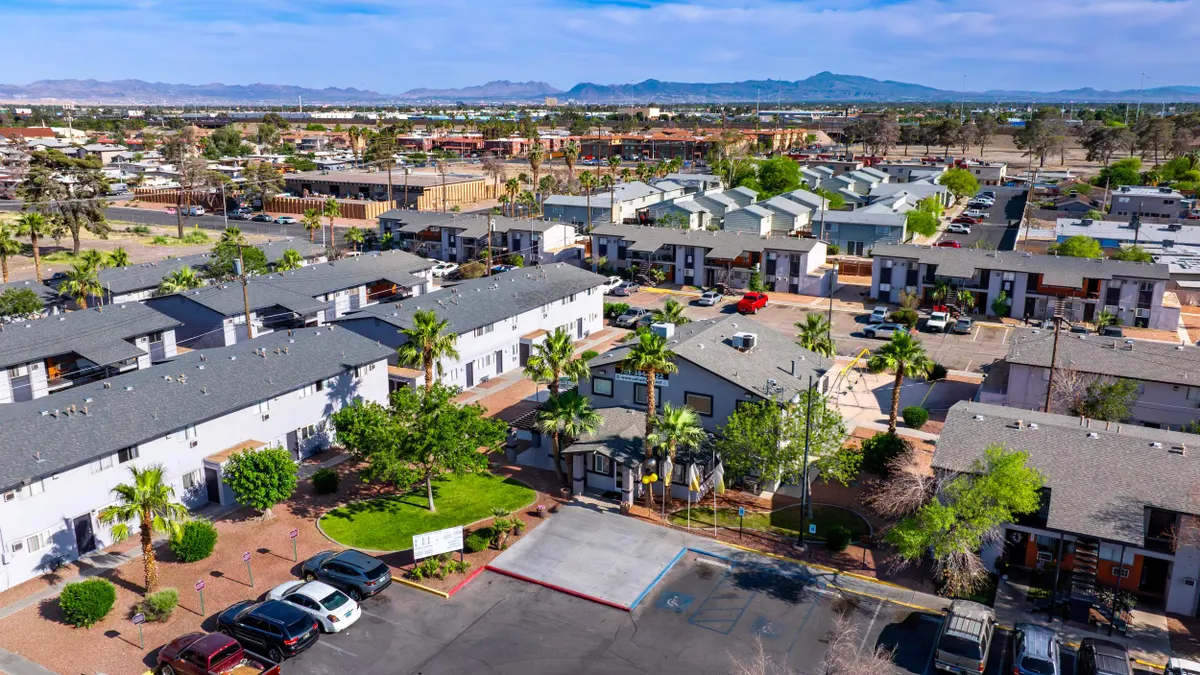
Many family-run real estate companies can feel like circuses. However, Westland Real Estate Group may be one of the only ones that actually traces its history back to the carnival business.
CFO Shimon Greenspan’s grandfather, Allen Alevy, started the business almost 50 years ago by operating the California State Fair. According to the company website, he built a mobile park on the fairgrounds for employees.
In 1976, after selling the state fair, he bought a mobile home park in Long Beach, California, where the company is based. The family also has ties to Las Vegas, where Alevy helped develop the Circus Circus Hotel and Casino.
“In 2011, we were there on a vacation and looked in the local paper because there was nothing else to read, and saw some classifieds for selling single-family homes,” Greenspan said. “And my grandfather said there's a few zeros missing on these prices.”
Curious, the family called a local broker asking about apartment pricing in Las Vegas. At the time, the firm had just under 2,000 units across roughly 100 properties in Southern California.
“The pricing in 2011 was like $17,000 a door,” Greenspan said. “It was very, very cheap real estate at very deep value. You couldn't build it for anywhere near what you could buy it for, and that's kind of an underlying philosophy of ours: ‘Is it cheaper to buy than build?’”
In Southern California, the largest Westfield property had about 90 units in 2011. “Coming into Vegas, our very first acquisition was 400 units,” Greenspan said. “So it was a different kind of scale.”
Over the past decade and a half, Westfield has built a portfolio with more than 11,000 units in Las Vegas, 2,700 in Southern California and just over 3,000 in San Antonio, Texas. In August, the firm acquired four properties, encompassing 713 apartments, in Southern Nevada.
Shimon’s brother, Yanki, serves as CEO of the firm, which takes a buy-and-hold approach to investing. It focuses on addressing the root causes of property issues and reducing long-term costs.
Here, Shimon Greenspan talks with Multifamily Dive about buying opportunities in the early 2010s, the end of extend-and-pretend and the scale needed to enter a market.
This interview has been edited for brevity and clarity.
MULTIFAMILY DIVE: What is the buying opportunity like in Las Vegas now compared to 2011?
SHIMON GREENSPAN: It’s not nearly as good, but I don't think we'll ever see another buying opportunity like those years across the Sun Belt markets in the 2011, 2012 and 2013 range. Anyone with access to capital and the foresight to recognize what pricing looked like relative to actual value would have done very, very well in those years.
We happened to buy in Vegas at the time. But other people that went into the Phoenix-Scottsdale area or Dallas or, pick a market, did well. The world washed out after the Great Financial Crisis, and access to capital completely dried up. Anybody who had a good balance sheet and a good track record could borrow and pick up real estate at an incredible basis. I don't think we'll ever see that again.
What kind of buying opportunities are you seeing in general right now?
It's really more incremental. We own 17,000 units and we're owner-operators, so it's all about scale. For instance, we have plumbing teams rather than hiring vendors. We can operate more efficiently. So when I underwrite a deal, I can see some value there.
But it's not an amazing opportunity. It's just kind of getting started. Volume has been pretty depressed pretty much everywhere in the last couple of years.
Tell me about the four properties you recently bought in Las Vegas.
Of the deals we bought, two were from estates. The father operated the property and then passed it on. Then the kids didn't want to operate real estate or weren't very capable of it. They didn't love the management company concept.
Being a family business and because of our capital structure, we don't have partners or anything like that. So, we were able to move very quickly, which allows us to put in offers that allow us to capitalize on that speed and get a really solid basis. These deals were low- to mid-six caps on our underwrite. Given the cost of capital, that’s not amazing. Long term, the easy operational scale to manage makes sense.
What are your typical deals like?
A lot of times, there's some hair on the deal. It needs some repositioning, stabilization and it's not necessarily managed very well. We tend to buy in cash. Then we bring in a balance sheet partner post-closing — somebody who understands our operating model. Then it takes us anywhere from 12 to 24 months effectively to stabilize the asset, and then we'll take that into the agency debt.
Do you expect to see more deals with some hair on them come to market?
We're underwriting a couple of deals a week across either Vegas or San Antonio, mostly San Antonio. There hasn't been a ton of movement yet in the market. But with the rally in rates, it may change.
People who got over their skis in 2021, 2022 and 2023 were underwriting double-digit rent growth forever and overpaying for assets. So, all that is coming through in this maturity wall, and the rents obviously slowed down.
That’s all being worked out and I think that a lot of sellers didn't want to sell. A lot of lenders didn't want to force the activity. Everybody was burned in 2008, where buyers came in and were able to scoop up assets at very low prices. I think the lenders learned from that and didn't want to force action too quickly.
How long do you think lenders will hold on?
A lot of extend-and-pretend was happening in the debt space. Everybody has been hoping that rates come down. In the last 90 days or so, especially with Warsh at the Fed, I think people are seeing that rates may not come to our rescue effectively. So I think we're going to start to see a lot of that stuff work out in ways that it hadn't previously been forced to work out.
Are you eyeing any new markets?
Because of the way we operate, we need scale. So, we're going to consolidate in a single market, and then optimistically move to a new market. In the next couple of years, we may look at new markets. But we're going to have to see washed-out pricing. I don't think it'll be 2008 level, but there will be washed-out pricing.
What we look for is a market with good job growth and good population growth — long-term trends that are moving in the right direction. We need to be able to get positive operating leverage in the deals.
Then we're looking at basis to make sure — because we're workforce housing — we’re going to get a discount on buying versus building new.
How many units do you need to feel like you have enough scale in a market?
If I’m going to get a foothold in a new market, I need to get to 1,000 units. The minimum per asset is 150. If it's less than 150, it's kind of too small to mess with.
Our mission and our promise is to deliver clean, safe and stable housing where our residents can make a home. That's what we try to deliver to our residents. We very much understand where we are. We have a workforce product. We believe that our residents should be able to live with dignity and have a nice place to live and not have to deal with criminals.
Click here to sign up to receive multifamily and apartment news like this article in your inbox every weekday.