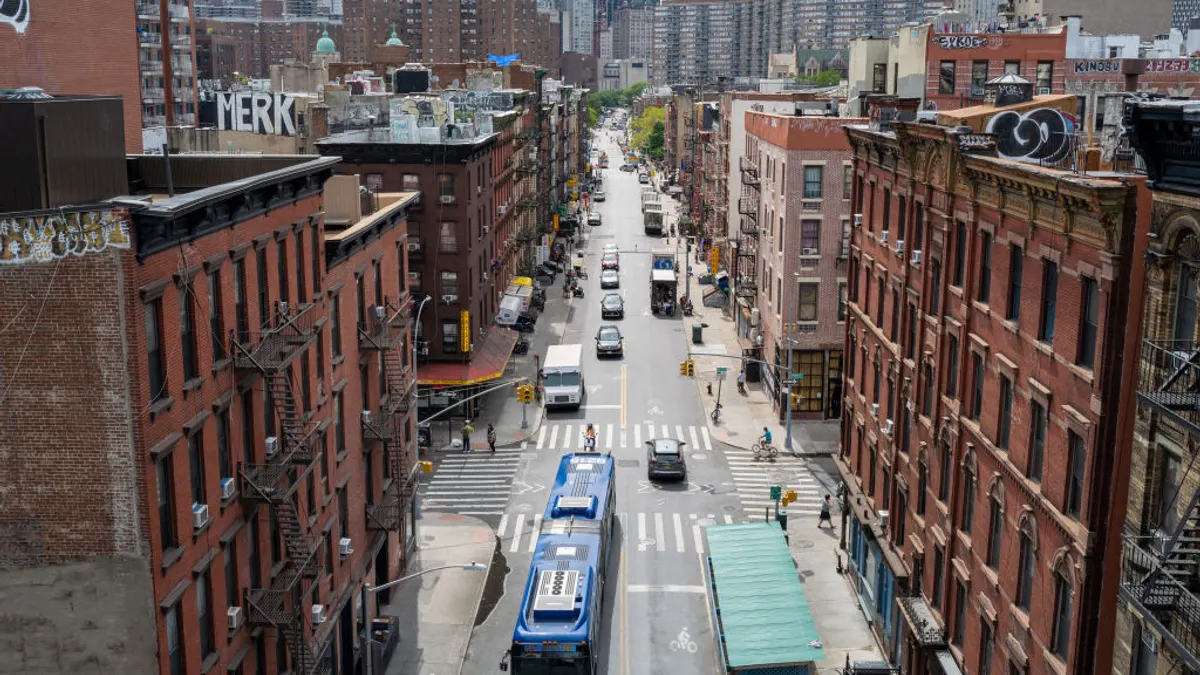
Transit-oriented development has proliferated in recent decades, according to June 4 research from the Urban Institute, a Washington, D.C.-based think tank, which found that developing dense, mixed-use and walkable neighborhoods within easy access to public transportation benefits renters, housing pros, transportation agencies and localities alike.
A corresponding new interactive tool from the Urban Institute’s Yonah Freemark, principal research associate in the Housing and Communities Division, explores where and how effectively states and urban localities have invested in TOD. It also shows that nationally, there are millions more homes near transit compared with several decades ago — and there’s an appetite for more.
“People just prefer living near transit if they can,” Freemark told Multifamily Dive. “The demand is there from residents, and you can see that in areas with really high-quality transit networks, where people actually have access to good transit that gets people where they need to go.”
Part of why people want to live in transit-rich areas is that shifting from cars to trains or buses can save them money on transportation costs, according to Freemark. That’s an important consideration for increasingly budget-cautious renters. This approach also reduces car congestion and pollution, making the surrounding area more appealing to live in.
“What that suggests to me is that there is a financial benefit to investors in going into areas near transit,” Freemark said. “People may actually be willing to pay more in rent and more in real estate in general, because they know they're able to not have a car or not have to pay the costs of the car on a daily basis.”
Indeed, access to rail and other quality transit is associated with higher rent prices, Freemark said. “You see that in the New York metropolitan area, you see that in the Washington, D.C., metropolitan area, you see that in the Boston metropolitan area, you see that in Chicago.”
More transit-oriented development ahead
Freemark expects the transit-oriented development trend to accelerate as communities around the country increasingly update their zoning incentives to encourage building around transit hubs.
“What we see is that cities and states are saying, ‘Actually we want to encourage more and more development in areas near transit,’ and they are actually changing the rules to do so,” Freemark said. “Over the last few months, we've seen some substantial changes to zoning in places like Illinois, California, Washington state, all of which encourage more development in those transit areas.”
More localities are developing their own TOD frameworks. For example, bill HF4449, introduced in Minneapolis in March, would establish a transit system investment framework, mandate alignment with road projects and set requirements for transit-oriented development.
There are also efforts at the federal level. The 21st Century ROAD to Housing Act, now before the Senate, contains provisions supporting TOD near existing or planned public transit stations. Rep. Laura Friedman (D-CA) also introduced the BUILD HUBS Act on Jan. 14, which would establish a TOD financing program, among other incentives. However, there has been no movement since it was referred to two subcommittees in January.
Barriers persist
One of the biggest impediments to transit-oriented development is poor-quality transit, Freemark’s research shows. Although many cities have expanded their rapid bus service in recent decades, most have not similarly developed their rail systems to keep up with population growth. In many areas, transit service is too infrequent or slow to encourage people living nearby to use these services.
Despite the wave of TOD-focused updates, exclusionary zoning codes continue to block dense residential construction near transit, per the report. Cities and states can enable high-density housing and commercial space near transit by upzoning and eliminating parking requirements.
Because dense housing and transit are mutually supportive, the multifamily housing industry needs to be thinking seriously about how it can boost quality transit, according to Freemark.
“The housing industry should be a supporter of transit investment and should see it as a complement to its own profit-making goals, because ultimately, transit can help make housing more appealing for people who want to live there,” Freemark said.
Jurisdictions should also promote joint planning between transportation and housing entities, per the report. Decisions on transit and housing investments are typically made by diverse institutions working at different geographical scales, and communities can foster TOD by coordinating investments. There’s room for the private sector here, according to Freemark.
As apartment investors think about what sorts of investments to prioritize and where to put their equity, “They have an opportunity to say, ‘We really want to focus our funds on transit areas, we want to make sure that the funds are going to places where people have these options to get around that are not just driving, and make sure that our new housing investments are corresponding to people's actual needs,’” Freemark said.
“I think it'd be great to see that kind of commitment from the housing industry.”
Click here to sign up to receive multifamily and apartment news like this article in your inbox every weekday.