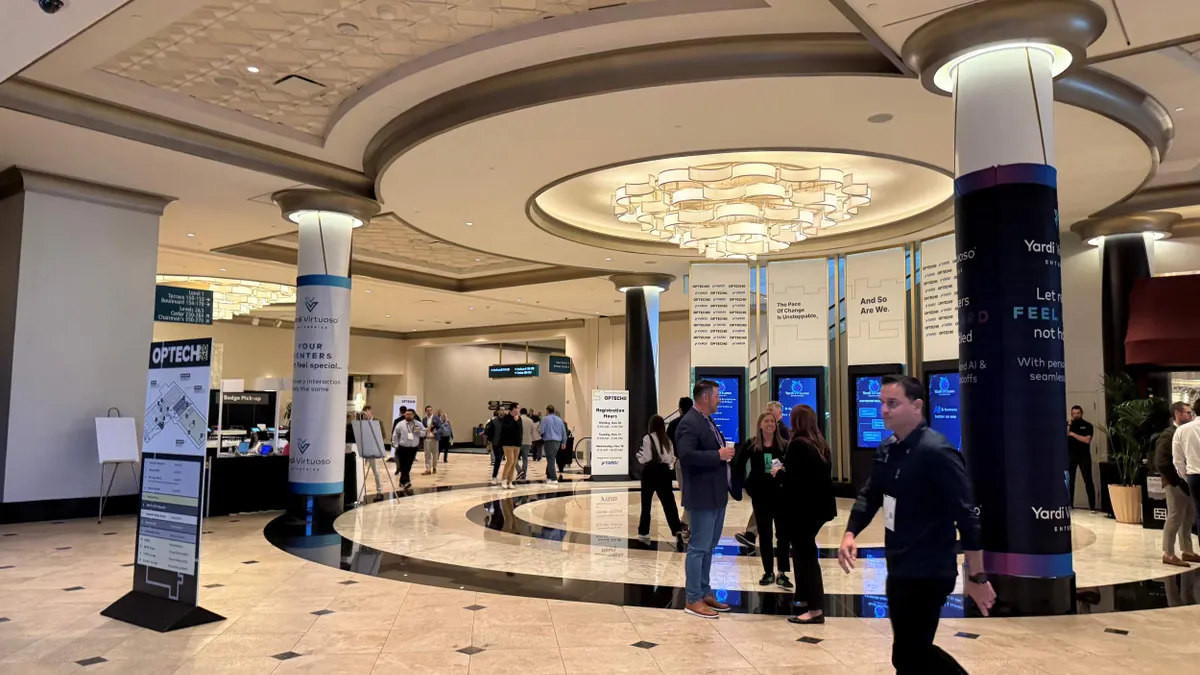
LAS VEGAS — The apartment industry is only in the early stages of artificial intelligence adoption, and it’s already seeing tremendous benefits.
But in the process, multifamily firms are still learning where to use the technology most effectively. For instance, Peter Lynch, chief people officer at Cardinal Group Cos., has learned to simplify AI messaging for his teams.
“AI is going to crush things at a repeatable rate. Our humans are going to crush things that we need to be remarkable,” Lynch said on Nov. 17 at OPTECH 2026 in Las Vegas. “Let’s think through that lens. Where are we trying to be remarkable?”
That distinction also applies when apartment firms decide whether to build their own systems or look to outside vendors for products.
At OPTECH, executives from Morgan Properties, the No. 2 owner in the country on the latest National Multifamily Housing Council Top 50, and Willow Bridge Property Co., the No. 3 manager in the country, explained how they utilize AI.
Willow Bridge
Willow Bridge Property Co. employs a three-prong strategy, starting with tools it can buy off the shelf.
“What's already there and available to our teams that we can implement immediately?” Jennifer Staciokas, chief operating officer at Willow Bridge Property Co., said. “Then where are those areas that we can build and partner with somebody from that strategy and reimagine the workflow that we're currently doing?”
The third prong is encouraging Willow Bridge employees to use Microsoft Copilot and, in some cases, Claude, to “get curious and start building something,” she said.
Since Staciokas rejoined the organization three months ago, several use cases have emerged, “where people have started building things and bringing them to the forefront. And we want to encourage that and then figure out a way to see if it's scalable across the organization,” she said.
One department worked with IT to build products for internal clients. Staciokas said that is “something that we will continue to scale as we move forward.”
But Staciokas also cautioned that while AI allows companies to move faster, they also need to slow down and explain how they found errors in AI-generated work.
“When we're looking at something that's an output from AI, and we may notice something immediately that is a discrepancy, we need to sit down with our team and walk through that,” Staciokas said. “And [then] share the experience and the context of how we knew that and how we came to that conclusion to bring them along on the journey.”
Morgan Properties
At Morgan Properties, technology teams are co-located within other departments to spot emerging trends and consider how the firm leverages tools to build custom applications that address customer experience, automation and productivity, Devang Patel, head of technology at the firm, said at OPTECH.
In some cases, such as customer relationship management, accounting and human resources, apartment firms could build their own systems. But they probably shouldn’t, according to Patel.
“There are so many different platforms and tools out there, and to me, it's pick one that works best for your company and your strategy, and just go implement that,” Patel said.
He says companies should focus their development efforts on tools that set them apart from competitors.
“If you’re window shopping and you're seeing the same sort of thing, maybe that's a differentiator, and maybe that is as an organization where you actually want to build something custom and differentiate yourself from your competitors,” Patel said.
But companies also can’t “AI your way out of everything,” though the technology does help drive efficiencies, according to Patel.
“It comes down to people,” Patel said. “So I think that is just a critically important factor. When you think about residents and you think about moments that matter, that personal touch and that human element is still so foundationally critical.”
Click here to sign up to receive multifamily and apartment news like this article in your inbox every weekday,