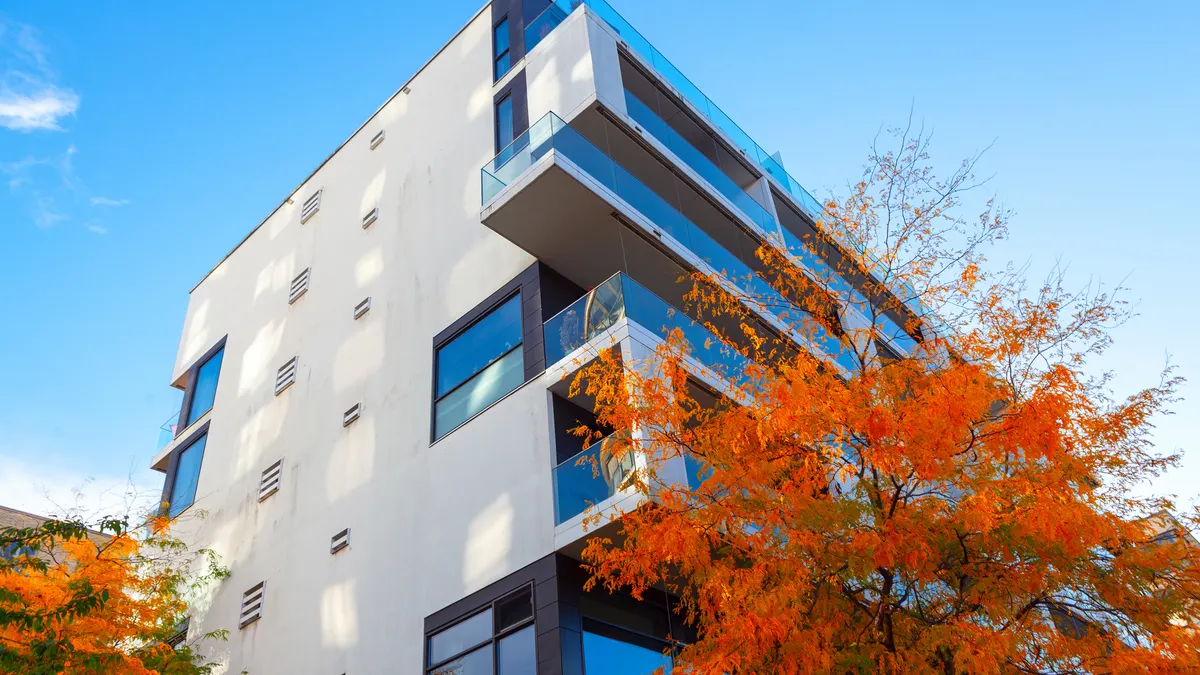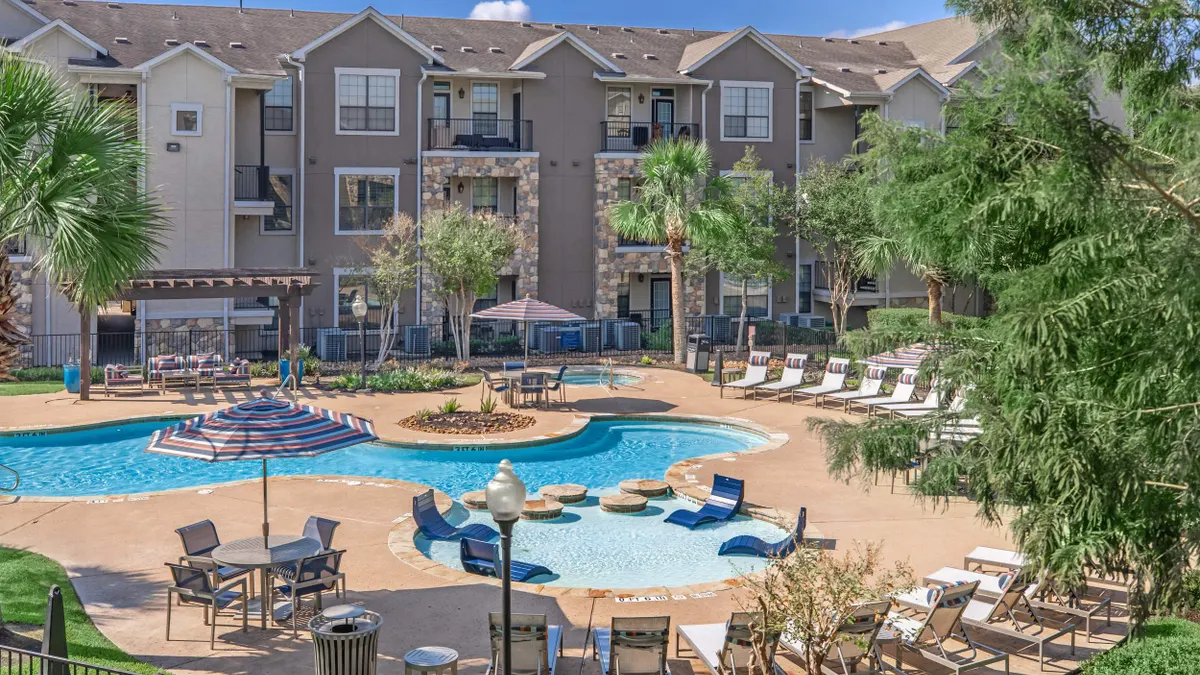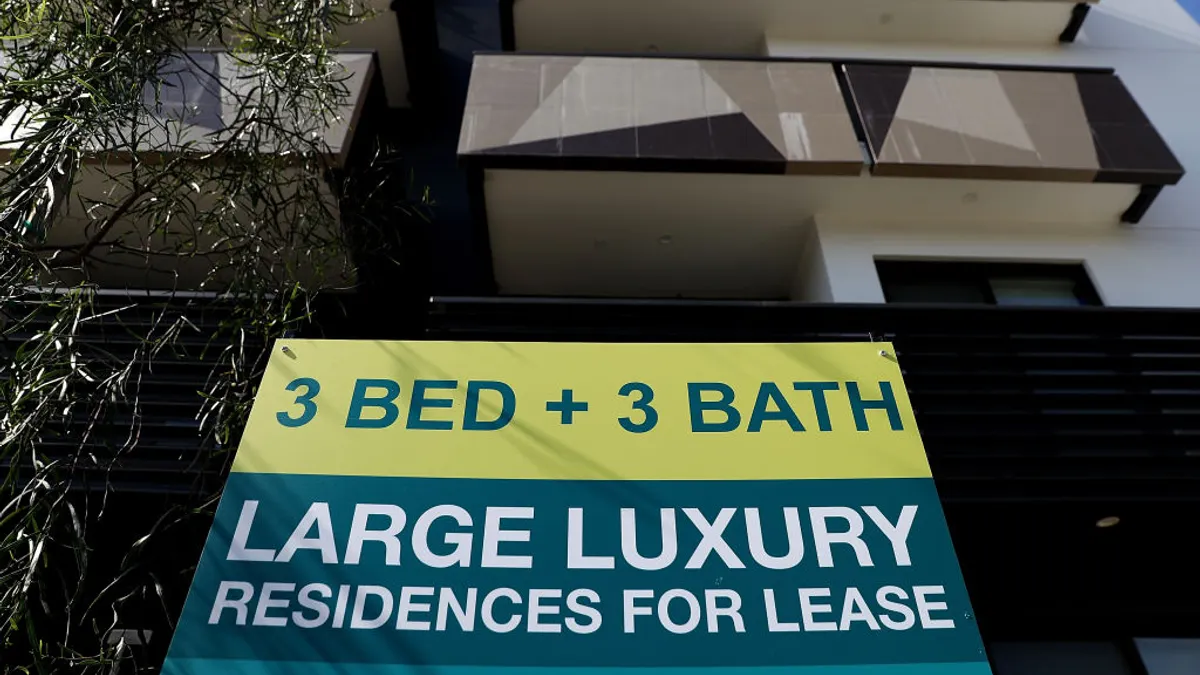
Although the pandemic-era apartment supply wave is abating, the high number of new apartments in the lease-up stage is suppressing the ability for operators to raise rents.
Paul Fiorilla, director of research at Yardi, found in a Sept. 4 analysis that rent growth is “highly correlated” with the number and share of new building stock in lease-up in a given market. At the beginning of August, 1.2 million units were in lease-up nationwide — down from the early 2025 peak of 1.4 million apartments, but about double the average seen in the previous decade.
“Even though demand is strong in most of these markets, just the sheer number of new units that need to get filled is really high. So it's taking longer to do it,” Fiorilla told Multifamily Dive. Because renters have so many options, “you can't charge as much as you otherwise would.”
Jay Lybik, senior director of market research at Continental Properties, told Multifamily Dive that “this is the most units we've had delivered in multifamily since the mid 1980s.”
Although the market conditions then are not directly comparable to today, “there are so many properties that are still in lease-up, and the impact of that has been much stronger and longer than anyone anticipated in the market,” Lybik said.
There are indications that things are moving in a positive direction, but as operators compete for tenants amid an uncertain economic landscape, it’s unclear how long it will take for rent growth to normalize.
Discounts still elevated
To entice renters, many new apartments are offering discounts. Concessions remain higher than usual, according to Lybik and Fiorilla.
“There definitely are more units offering concessions today than three years ago,” Lybik said. “[Operators] are trying to fill the units any way they can.”
The impact of these discounts is lingering, according to Fiorilla.
Operators are frustrated because “they need to offer concessions in order to retain — not only to attract, but also to retain — tenants,” Fiorilla said. “As the market improves, concessions will diminish, but it's going to go down slowly because people have gotten used to it. They expect them, and if they don't get them, they'll look somewhere else.”
It’s not just new apartments using concessions to attract tenants. In recent years, more older buildings are also offering discounts, and although the percentage is “not as large as we saw for those 2020 properties, it's definitely higher than it was,” Lybik said. He pointed to recent RealPage data that shows about 25% of units in buildings built in the 1990s are offering concessions, up from 18% three years ago.
In July, national apartment concession use slumped to 15.8% of stabilized units and was highest in the supply-soaked South at 21.1%, according to RealPage Market Analytics data analysis published Sept. 4. Still, the national average discount remained well above year-ago levels in every region, “leaving a market landscape defined by narrowing breadth, durable depth, and a widening gap between where concessions are common and where they are deep,” according to RealPage.
Turnover is also part of the equation, according to Fiorilla. In high-supply markets, much of the “income growth that properties are getting comes from renewal leases, because new leases on vacant units are very often, on average, less than the previous leases. So net income is growing very slowly, and to the extent that it's growing, it's growing because of lease renewals.”
Geography matters
As ever, the situation varies widely by geography, and it’s difficult to talk about a national trend in lease-ups because “we're seeing distinct differences depending upon the region you're in,” according to Lybik. The areas with the highest number of apartments in lease-up are in the Sun Belt markets, while the Midwest and the Northeast are more stable.
“Atlanta is definitely doing better than the pack. Jacksonville is definitely doing better than the pack,” Lybik said. “But the majority of the Sun Belt markets are seeing negative rent growth, and they're dealing with this overhang of units that are just not absorbed yet, and it's killing the ability to get any positive rent growth in these markets.”
Yardi’s analysis found that Charlotte, North Carolina, had the highest percentage of apartments in lease-up at 11.6%. It’s followed by Austin, Texas (10.9%), Phoenix (9.8%), Nashville, Tennessee (8.9%), Orlando, Florida (8.5%), and Raleigh–Durham in North Carolina (8.1%).
RealPage found that Austin, Texas, led the top 50 national markets in terms of concessions offered, on 37% of stabilized units at an average discount of 15.2%, followed by San Antonio, Texas (32.6%), and Denver (31.7%). Phoenix had the deepest discount in July at 15.4%.
Even though positive signs exist, Fiorilla said he thinks “it's going to take probably a few quarters” for rents to recover.
“If things continue to go in the direction they're going, and occupancy rates improve and demand remains strong, and supply continues to decelerate, then I can see rent growth coming back in these markets after a few quarters,” Fiorilla said. “But it's got to keep going that way, and that's by no means certain.”
Click here to sign up to receive multifamily and apartment news like this article in your inbox every weekday.