The number of finished multifamily construction projects declined last year — welcome news for multifamily operators eager to work through the recent supply wave — and a record share of new apartments were high-density, according to the National Association of Home Builders’ Monday analysis of the Census Bureau’s Survey of Construction.
Dating back 1972, the series’ earliest estimates, most apartments have typically been constructed in buildings with less than 50 units. This trend reversed in 2017 and has since remained unchanged. Now a majority of new multifamily units are in high-density buildings.
Smaller apartment projects are increasingly financially unfeasible, according to 2025 analysis from the Urban Institute. The shift away from smaller builds looks likely to persist for now: With the current high interest rates and land prices, developers are incentivized to build larger, denser projects in order to make construction pencil out and to minimize operating costs.
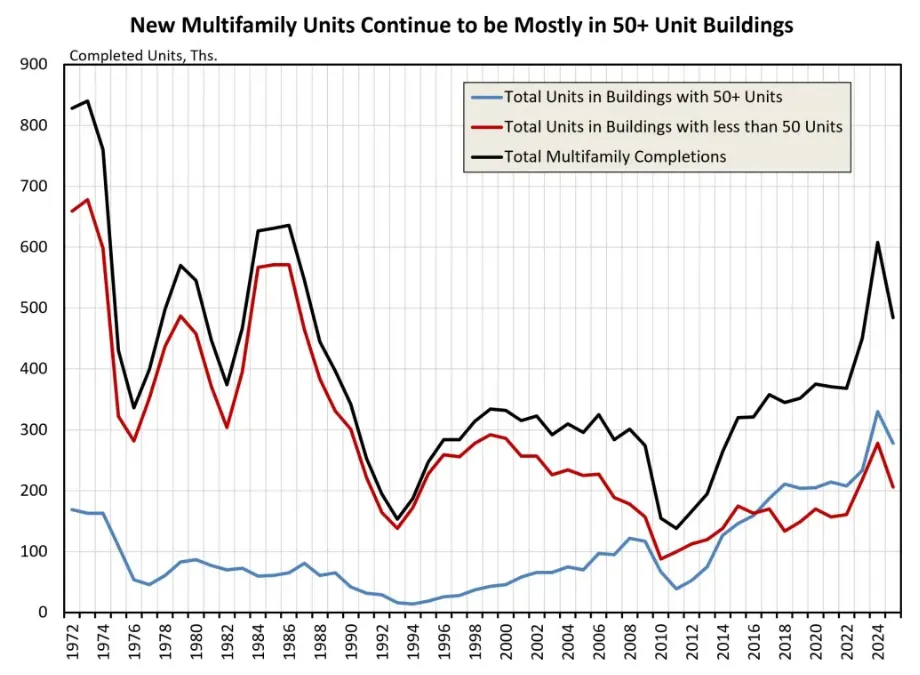
After a nearly 40-year high in 2024, the overall number of apartment completions fell from 608,000 units to 484,000 units in 2025.
The South continued to lead U.S. regions with the most apartment deliveries, with 45% of the country’s total completions, according to NAHB. That number is dropping, however: Last year the South saw 217,000 completions, down from 292,000 in 2024.
The West was second in 2025 with 26% of the country’s multifamily completions, while the Northeast had 16% and the Midwest had 13%.
Here are other trends the NAHB identified in the Census’ 2025 survey.
Apartment density varies by region
A majority of the 484,000 new multifamily units, 57%, were in buildings with 50 or more units — the highest share since 2021, according to NAHB. The remaining 43% were in low- or medium-density buildings.
The South, West and Northeast had more high-density completions than low-medium ones in 2025. The Midwest was the only region where low- or medium-density projects outpaced high-density ones, and it was also the only region where the share of high-density units declined.
The Northeast saw the largest divergence in building types, with 58,000 new high-density units last year — representing the highest-ever level at 73% of total construction — and only 21,000 new low- or medium-density units.
Build-to-rent vs. build-to-sell
The vast majority of the multifamily units completed last year — 95% — were built to rent.
Nearly 60% of these units were in a building with 50 units or more, the highest share in high-density buildings since 2021. 2025 marked the ninth consecutive year where most newly constructed apartments were high-density.
The number of built-for-sale multifamily units declined from 29,000 in 2024 to 23,000 last year. High-density buildings continued to account for the majority of these new units, but that share fell from 40% in 2024 to 32% in 2025.
The largest increase in market share for multifamily built-for-sale units was in small apartment buildings with 10-19 units, up from 13% in 2024 to 24% in 2025, representing the sector’s second-largest segment.
Click here to sign up to receive multifamily and apartment news like this article in your inbox every weekday.