UDR’s $2 billion joint venture with Apollo got generally good reviews from Wall Street analysts after it was announced last week.
Anthony Paolone, executive director at J.P. Morgan, called the JV “positive, in our view, and important, given that cap rates are likely 25bps or more higher today.”
In the deal, Apollo-managed funds and affiliates will invest $1.34 billion of capital, acquiring an approximate two-thirds interest in the 19 properties that total 7,059 units. UDR, which will retain a one-third interest, will continue to operate and manage the portfolio and earn an asset management fee equaling 1.25% of Apollo’s equity, or $16.75 million, Paolone said in a research note.
The deal seems to accomplish multiple goals for UDR, including lowering the average age of its portfolio, generating liquidity for new deals and stock buybacks and boosting fee-management returns. However, Apollo is a sophisticated operator and there are many unknowns, according to Paolone.
Portfolio rebalancing
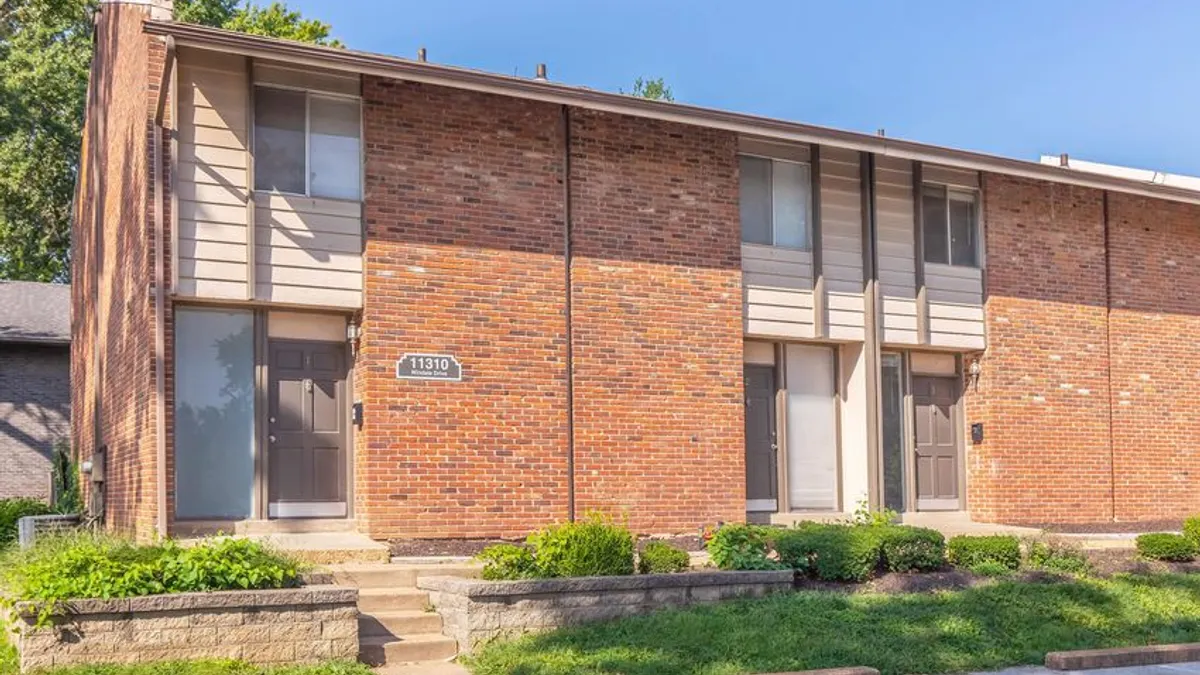
In generating liquidity, UDR is trading out of older assets with the JV. The 19 properties, which carry a 6% cap rate, have average revenue per unit of $2,058 and an age of 39 years, per the release from UDR.
By comparison, in the second quarter of 2026, UDR’s average rent was $2,642 for its 2Q26 same-store portfolio, Michael Lewis, an analyst for Truist, said in a report shared with Multifamily Dive.
Removing the older assets enhances UDR’s “remaining same-store NOI growth rate,” Paolone wrote.
The deal also shows that the jump in 10-year Treasury yields may be affecting valuations. “The quoted 6.0% cap rate appears to signal apartment cap rates may have moved up amid the recent spike in interest rates, though it is below the 6.4% implied cap rate on UDR’s stock,” Lewis wrote.
Piper Sandler analyst Alexander Goldfarb concurred, writing that the valuations “are beginning to reflect the 5%-handle 10-Year,” with a 6% forward economic cap rate versus a net asset value cap rate of about 5%, he said in a report shared with Multifamily Dive. By comparison, Independence Realty Trust acquired Centerspace at 6.8%, which shows “the cash flow disconnect between the Midwest and Coastal/Sunbelt,” he wrote.
Low cost of capital
With the transaction, UDR will gain “access to a new, low-cost permanent source of equity capital,” CFO Dave Bragg said in the release. The REIT expects to deploy the proceeds into high-growth assets and other general corporate purposes.
“The JV provides significant capital to improve/de-lever the balance sheet and pursue new investments,” Lewis said.
Paolone said that UDR management expects to use the proceeds for acquisitions in the 5.25% to 5.5% cap rate range, debt paydowns and stock buybacks. He also noted that REITs in other sectors, like Realty Income in net lease, have tapped capital through JVs.
“The fees and structure provide UDR with low-cost capital, though with some added complexity and some unknowns around the long-term features of the deal,” Paolone said. “It should be about 1% accretive to the bottom line, which is helpful in a low-growth area like multifamily right now.”
Management fee boost
Paolone said UDR’s management fee was “sizable” and set the deal apart. With a 6% cap, the $2 billion portfolio would generate about $120 million in net operating income.
He said the venture appears to deduct $16.75 million in management fees, pay for capital expenditures and then make a distribution. With a modest capital ex of $10 million, the cash flow for partners would be $93.25 million, according to Paolone.
Paolone projects Apollo to receive $62.5 million, or a 4.7% cash return on its investment, while UDR will earn $30.8 million in distributions plus its management fees for a total of $47.5 million. The REIT should be able to produce at least a 5.5% return, or $71.5 million.
UDR’s total cash coming in from the deal should be $119 million, compared to $110 million from its wholly owned assets.
“Our understanding of how these insurance company deals work is that each party receives pro rata distributions of cash flow,” Paolone wrote.
Devils in the details
At the fifth anniversary of closing, UDR will have the option to repurchase Apollo’s interest in the JV. While the deal looks like a winner for UDR, Paolone admitted there “could be devils in the details.”
“Apollo is a sophisticated counterparty, and we find it hard to believe it is doing these deals in a manner that is completely favorable to the other party,” Paolone said.
It's also unclear what “downside support” UDR is providing to Apollo. “In the few deals we’ve seen REITs do with insurance companies, the finer points have not been disclosed,” he wrote. “This is something we’ll have to watch over time, and it does add complexity, of which we are not a fan.”
Still, “on net” the deal looks good for UDR, according to Paolone. “It sheds lower-quality assets at a price level that seems to have been set a few months ago,” he wrote. “It will collect fees and add to earnings. It should be good for the stock near term.”
Click here to sign up to receive multifamily and apartment news like this article in your inbox every weekday.