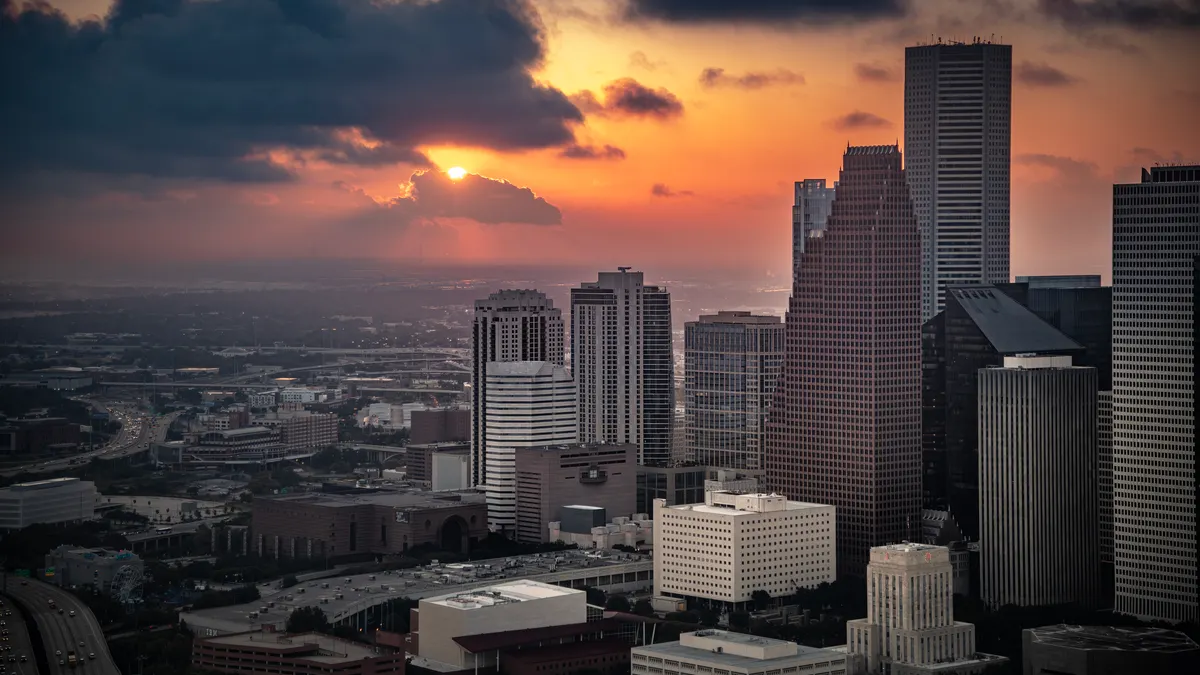
When apartment loans began going bad a few years ago, Houston was one epicenter as Applesway Investment Group defaulted on nearly $230 million in loans for 3,200 units in the city in April 2023.
More than three years later, Houston and, more broadly, Texas rank among the leaders in securitized multifamily loan issues, according to research that Trepp shared with Multifamily Dive.
“Texas is not the highest-stress state for securitized multifamily loans, but it does rank meaningfully elevated nationally,” Stephen Buschbom, Trepp's head of applied research and analytics, told Multifamily Dive in emailed comments. “Houston also stands out more clearly at the MSA [metropolitan statistical area] level.”
While Texas is tied for fifth among states and Houston is fourth among metro areas, some apartment owners in the Lone Star State and its largest cities face rising costs and unique tax circumstances that are placing additional pressure on their properties. In addition, they’re still dealing with supply constraints and higher borrowing costs, which are affecting other landlords across the country.
But the state has always presented special challenges, according to Patrick Carroll, founder of Carroll Holdings.
“Texas seems to always be a bloodbath,” Carroll previously told Multifamily Dive. “We bought stuff in Houston, but somebody once told me, ‘Houston is a place where equity goes to die.’ You can look at stuff, and you’re like, ‘Well, it’s cheap on a price per unit,’ but you just have a lot of delinquency and things like that.”
Changes in Housing Finance Corporations
Over the past decade, some apartment owners and developers in Texas relied on Public Facility Corporations and, later, Housing Finance Corporations to get property tax exemptions.
After making the PFC process more onerous in 2023, Texas enacted House Bill 21, an affordable housing law that significantly changed how the state’s affordable housing projects can access property tax exemptions. The law changes created uncertainty around tax exemptions and triggered the transfer of at least five properties into special servicing, according to Morningstar.
For owners, the sudden change in the law meant they had to fill an unexpected financing gap. “You need to put that $2 million property tax back, so that means that you cannot even cover your loan,” said Carlos Vaz, founder and CEO of apartment owner CONTI Capital.
For instance, The Riley in Richardson, Texas, transferred into special servicing earlier this year. Participating in the Garland Housing Finance Corporation program allowed the property to be exempt from real estate taxes if it met certain conditions and required mandatory prepayments if it failed to qualify or lost that exemption, according to Morningstar.
In April, Morningstar Credit reported that the Domain at Waco and NTX Denton entered special servicing after Nitya Capital CEO Swapnil Agarwal was unable to secure a property tax exemption due to a change in Texas law that closed the PFC loophole. That forced him to pay down the loan to meet a 10.33% debt yield hurdle.
Agarwal told Multifamily Dive that he has set up a plan to pay the lender, Argentic Real Estate Finance, in $1.5 million installments if exemptions with Waco and Denton County don’t occur.
Argentic and Denton County didn’t reply to Multifamily Dive’s request for comment. Jim Halbert, chief appraiser for the McLennan Central Appraisal District, didn’t confirm an exemption.
Regardless of individual circumstances, owners who relied on tax-exempt funding face an uphill battle holding onto their properties. “Thank God we didn't do any of those,” Vaz said.
Rising costs
Without property tax exemptions, which also exist in Florida and other states, it will be difficult to get apartment deals across the finish line, according to Agarwal.
“A lot of people have taken advantage of this law,” Agarwal said. “The math doesn't work otherwise.”
Add in rising expenses, and a Ph.D. mathematician won’t be able to make the numbers work. Insurance costs have moderated, but Agarwal said water, gas, trash and electricity have gone up.
“If people are paying normal property taxes, insurance, payroll, utilities, and then they're paying a mortgage that was originated in 2021 and 2022, your whole capital structure is upside down,” Agarwal said.
Top multifamily delinquency rates by state
| State | 30+ day delinquency rate |
| New York | 2.61% |
| District of Columbia | 2.59% |
| Mississippi | 1.80% |
| Louisiana | 1.48% |
| Indiana | 1.39% |
| Texas | 1.39 |
SOURCE: Trepp
In Texas, where there is no state income tax, commercial property owners carry a larger share of the revenue burden, according to Agarwal.
“In Texas, property taxes are anywhere between 30% and 40% of your operation expenses,” Vaz said. “So property taxes need to be fighting a lot, but to me, payroll is one that has been substantially going up, even medical insurance for employees.”
Finally, 1970s- and 1980s-era properties have inherent issues with systems like plumbing that can cost hundreds of thousands of dollars to repair. In Texas, the clay soil can be especially tough on older underground pipes, Venkat Avasarala, founder of Dallas-based Stryker Properties, told Multifamily Dive in 2023.
“A C-class property has lower rents, higher delinquency, higher capital expenditures and higher insurance costs,” Avasarala said.
Supply hangover
As if tax law changes and rising costs weren’t putting enough pressure on apartment owners in Texas, many areas are still working through massive amounts of supply.
“Dallas and Houston are in a much better situation than Austin, but still in those markets it has not been easy,” Vaz said. “With a chance of potentially a rate increase that can become even worse.”
The poster child for that problem is Austin. In 2025, deliveries peaked at 30,002 units, or 8.7% of stock, in Texas’ capital, well above the national rate at 3.1%, according to Yardi Matrix. An additional 22,602 units are underway at the time.
To compete with those new deliveries, apartment owners have to lower rents and spend more money.
Top multifamily delinquency rates among the 25 largest MSAs
| MSA | 30+ day delinquency rate |
| San Francisco-Oakland-Fremont | 5.69% |
| New York-Newark-Jersey City | 2.27% |
| St. Louis | 2.03% |
| Houston-Pasadena-The Woodlands | 1.90% |
| Detroit-Warren-Dearborn | 1.90% |
SOURCE: Trepp
“You have so much new supply, and you need to give a lot of concessions,” Vaz said. “Then what happens is your marketing starts to get much more expensive, because you really need to fight for that new resident.”
As concessions have risen, values have fallen, at least in Austin, with prices for brand-new properties dropping 30% to 40% below replacement costs, according to Vaz.
“It [the prices] gets you excited on one hand,” Vaz said. “On the other hand, the rents are so negative. It's like, ‘How long do I need to carry this deal here until it's positive again — just the cash flow along? That's the conundrum that you have.”
But, as Vaz points out, high apartment supply, unlike changes in the HFC laws, is not just a Texas problem. “You're going to find the same issues in Phoenix and if you go to Nashville,” Vaz said. “It's even in Florida, depending on where you are in Florida.”
Click here to sign up to receive multifamily and apartment news like this article in your inbox every weekday.