After it sold its management business to Greystar in 2020, Alliance Residential Co. has made its mark as a developer.
In the latest National Multifamily Housing Council Top 50, it ranked No. 4, with 5,501 starts in 2025. However, in 2023, it was No. 1 with a whopping 13,480 starts, and in 2022, it was No. 2 after breaking ground on 11,739 units.
But the Scottsdale, Arizona-based firm has also gotten back into the investment market in a big way. Between December 2025 and March of this year, it acquired more than 2,000 units across California, Texas, Florida and Pennsylvania, according to a press release shared with Multifamily Dive.
“Over the last decade, we have primarily been focused on development,” Stephen Squatrito, managing director of acquisitions – west for Alliance Residential Co., told Multifamily Dive.
“But now that the cycle is more back in favor toward buying, we have staffed up and we have grown our acquisitions team and platform.”
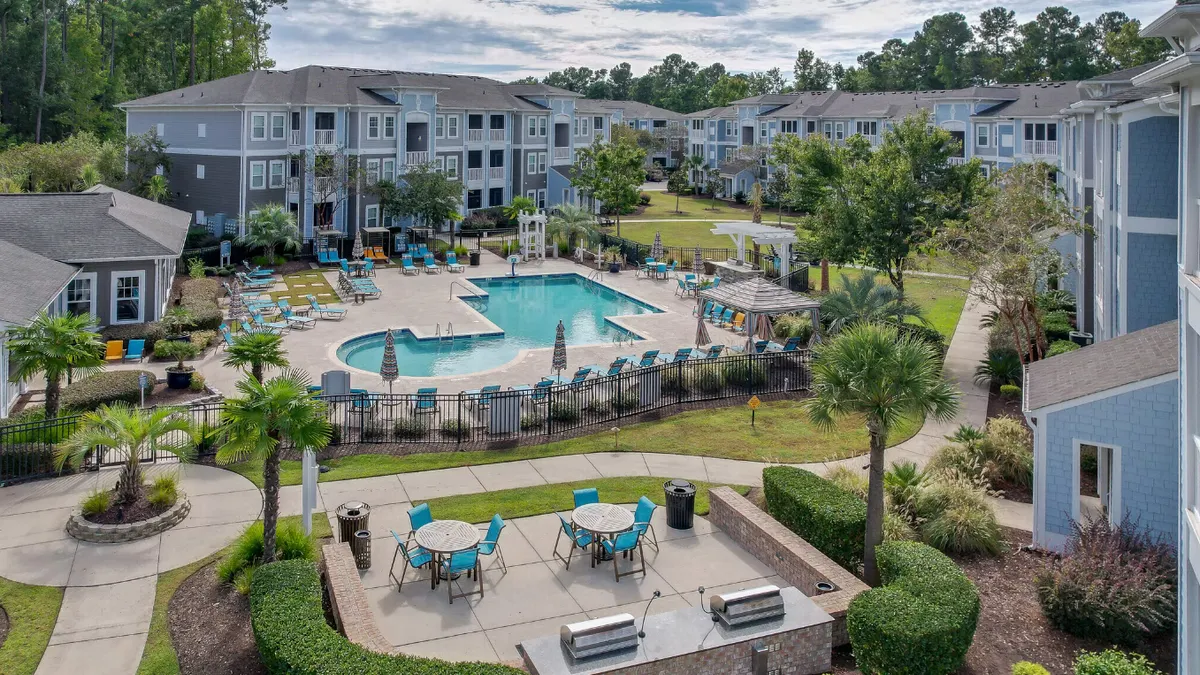
Since late 2025, Alliance purchased Hawthorne Apartments in Riverside, California; Broadstone Miracle Mile in Los Angeles; Wyncrest Bala Cynwyd in Philadelphia; Santoro in Houston; and North Park Landing in Fort Worth, Texas, at a significant discount to replacement cost, per the release. It also expanded its presence in Orlando, Florida, with the acquisition of Stevens Pointe in January and Avalon Pointe and Horizons Village in May.
The firm is targeting properties in the Inland Empire in California, greater Los Angeles, Philadelphia's Main Line, Houston's The Heights/Memorial corridor, Florida, and North Texas, per the release.
“We've created a dedicated East Coast team, and have grown our West Coast team here as well to source and execute,” Squatrito said. “So we can hopefully get as many buys here before things start getting too expensive too soon.”
Here, Squatrito talks with Multifamily Dive about the competition for deals, new construction acquisition opportunities and the development climate.
This interview has been edited for brevity and clarity.
MULTIFAMILY DIVE: When did you really start focusing on acquisitions?
STEPHEN SQUATRITO: We've been slowly picking our spots, really, since 2022, trying to find assets and opportunities that speak to the below-replacement-cost story while also capturing our value-return strategies. We had some success sporadically through 2024. We had one or two in 2025, but we've really put a lot of effort out into the world in 2023, 2024 and 2025.
Then, finally, it seemed like the bid-ask spread started to compress a little bit. Some of these deals started six months prior to the close date. In Q1, we closed six new projects, and we’re about to close another three.
Are you targeting older, value-add deals, newer projects or all of the above?
Up until 2023 and even still today, value-add remains our core strategy. But as of late, we have been equally focused on newer assets, more well-located assets, that we can buy below replacement cost or where we're seeing operations are impaired.
In some cases, we’re infusing new capital into underfunded properties and letting them stabilize. All in all, this allows us to wait out what we see as the supply overhang or inject new capital to allow properties to stabilize. So we can see real value in that. We’re also correcting operations. Some companies have self-managed or underallocated personnel in this competitive environment.

We're still solving to what we would consider value returns, but we've really opened up the horizon on what that product looks like. It's not just early-2000s properties where we’re redoing countertops, although that still exists in today's world.
Is it difficult to find and secure these properties?
Sourcing is taking more effort. The wins are increasingly off-market or in second-round sale efforts. Broadly marketed processes are still very crowded. A lot of the capital that is out there is going for the same small set of projects. That said, everybody is pretty consistent, to a degree, in how they value them.
Where are you finding these properties?
We are finding lingering properties in larger, closed-end funds, and so they're finally saying, ‘Okay, we're getting out.’
Or, they are truly impaired, debt is coming due, and they don't have a ton of options. It requires a huge capital injection that they don't have, or, in some cases, certain sub-markets and MSAs still have a perceived two to three years of turmoil, and it's potentially an idea where the first loss is the best loss.
Does it take more time to find these deals?
It really takes a lot to shake these loose. It takes a lot more time than it has in the past. We're staying diligent, staying close to these opportunities and continuing to follow up.
We're starting to see more of those where we spent time previously starting to come back around. We’ve either found a more willing seller or operations have improved just enough at the site where we're able to increase our view of the project. Then, therefore, we close the gap on both sides.
What are the circumstances behind many new-construction properties hitting the market?
Maybe they’ve already taken their construction loan off and now they’ve put that higher-octane debt fund money to work. With that coming due, to extend it or put new debt on there, that would require a huge capital injection.
There are also circumstances where the property just cannot get leased up. Therefore the value is still far enough below the construction loan that a refinance just isn’t palatable. But I would say most of the opportunities where there is some sort of debt stress largely isn't on the construction debt.
How is Alliance looking at development in the near term?
The development door isn't closed by any means. But it's just a lot harder to find those opportunities that really make sense, given where the environment is today. The same dynamics that make the acquisitions attractive also make the ground-up harder to pencil.
Construction lending has started to loosen a bit. With where effective rents are, it's really difficult to have an untrended yield that capital partners are looking for. That said, developments that are breaking ground now probably would deliver in 2027 and 2028 to what's perceived as a far less crowded field of competition. So I think the backdrop is very favorable for disciplined starts.
Click here to sign up to receive multifamily and apartment news like this article in your inbox every weekday.