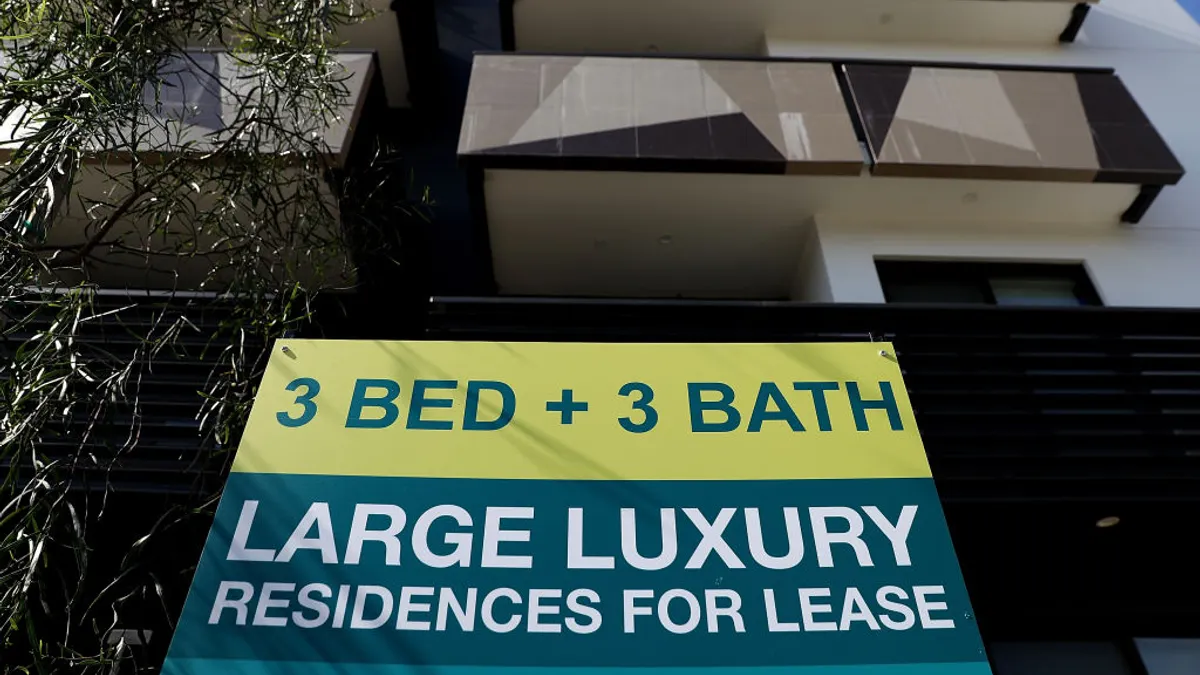
Apartment rents ticked up from March to April but remain lower than a year ago as operators see less than the usual seasonal bounce, according to an April 30 report from Yardi Matrix. Rents are down YOY in almost two-thirds of Yardi Matrix’s top 30 metros.
The average advertised rent in the U.S. grew $4 month over month in April to $1,758, which was down 0.2% year over year and represented about one-third of the average growth rate between 2012 and 2019, per the report.
“While April saw a second month of growth after declining during the winter, the increase was tepid,” according to Yardi. “The $4 increase is less than the usual seasonal bump and will hardly excite those looking to return to normal growth levels.”
Advertised rents in single-family build-to-rent properties rose $7 month over month in April to $2,211, but were down 0.5% year over year. There are signs that a measure in the 21st Century ROAD to Housing Act that would force operators to sell their BTR SFRs after seven years is already impacting Houston, one of the country’s biggest BTR markets, per Yardi.
Headwinds
The elevated volume of new apartment supply working through lease-up remains the primary constraint on rent growth, according to Yardi. Demand has also softened and absorption has stagnated in the past few quarters.
Consumer confidence is low and job growth remains soft, per Yardi. Many households face growing difficulties in the so-called K-shaped economy, which describes how higher-income households are increasingly better off, while lower-income ones are falling further behind, according to CNBC.
The ongoing war in Iran has also contributed to elevated energy prices, which are constraining household budgets, per the report. Since negotiations with Iran appear stalled, there is limited visibility on when these pressures may ease.
“Many in the industry are expecting/hoping that rent growth will return to the long-term average in the 2.5% to 3% range, but that may not be on the near-term horizon,” according to the report. However, “to get to the long-term average, rent growth must turn positive in markets in the Sun Belt and Mountain West that have recorded negative growth over the last two years.”
With moderating population growth, cooling migration and an uncertain economic outlook, a near-term acceleration in demand appears unlikely, per the report. Nonetheless, rent growth is expected to increase gradually as inventory is absorbed over time.
Strategies and opportunities
The highest rent gains continue to be concentrated in primary markets such as New York, Chicago and San Francisco, as well as Midwest markets like Minneapolis and Saint Paul, Minnesota; Kansas City in Missouri and Kansas; and Indianapolis.
Charlotte, North Carolina; Houston and Austin in Texas; Orlando and Tampa in Florida; and other markets saw MOM and YOY rent declines in April. However, several other high-supply markets are showing early signs of stabilization: Miami; Phoenix; Raleigh, North Carolina; Denver; Nashville, Tennessee; and Dallas all posted growth in April but declined year over year.
“While this improvement is not yet broad-based or sustained, it suggests conditions may be beginning to turn a corner, though a gradual recovery is still expected,” according to Yardi.
Regardless of overall performance, each metro area has pockets that outperform the larger market depending on the local economic picture and supply characteristics, per the report. Investors can also find opportunities in distressed and value-add assets.
“Many apartment properties have distress resulting from the rise in interest rates in 2022,” according to Yardi. “Lenders have been extending underwater loans for two years or more, trying to avoid foreclosure in hopes that property performance improves or that they find a capital infusion. But as time goes on, pressure grows to clear such loans from lenders’ books.”
This is also a good time to review operating expenses, which have increased by an average of 30% over the past five years, according to Matrix Expert.
“Among the ways to cut expenses are upgrading technology to improve efficiency and reduce energy costs, and enhancing property safety and security to lower insurance premiums,” per Yardi. “When revenue growth is weak, reducing expense costs is the best option to increase net income.”
Click here to sign up to receive multifamily and apartment news like this article in your inbox every weekday.