Dive Brief:
- On Monday, Brian Schwalb, attorney general for Washington, D.C.,filed a lawsuit against Mid-America Apartment Communities, also known as MAA, and its subsidiaries, Mid-America Apartments LP and Post 1499 Massachusetts LLC, for allegedly charging junk fees and hiding the true cost of rent from prospective tenants, according to court documents.
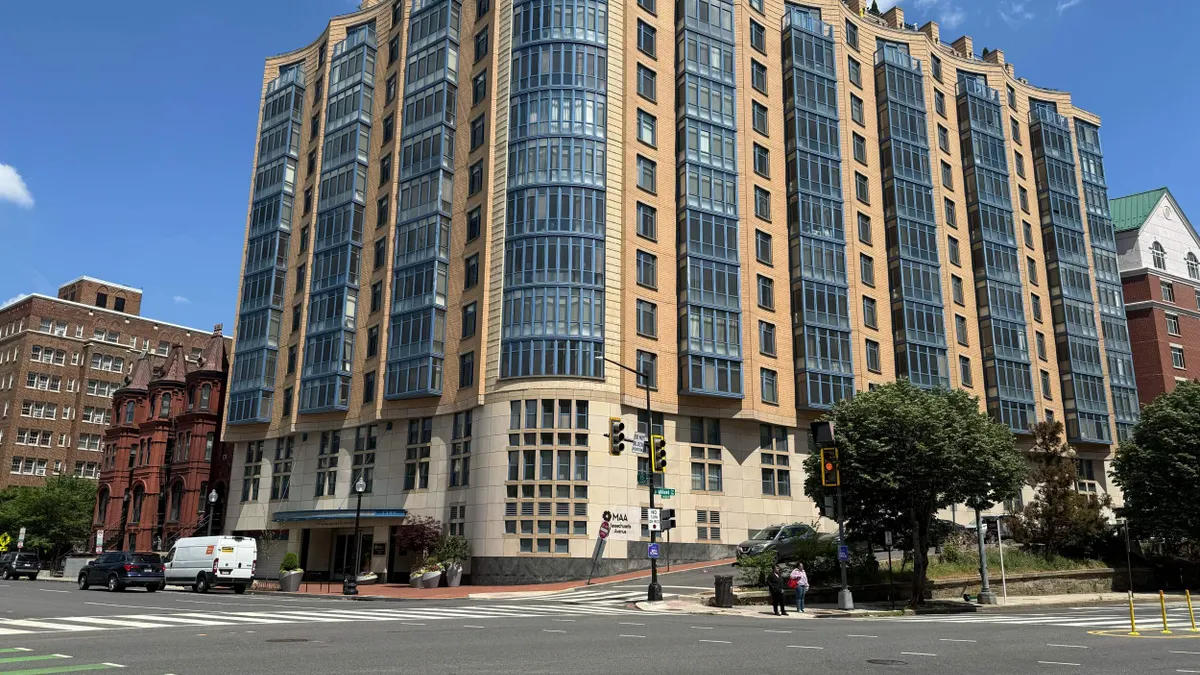
- MAA owns and manages a 269-unit apartment building located at 1499 Massachusetts Ave. NW. The Office of the Attorney General alleges that the REIT overcharged tenants and violated DC law by assessing a variety of illegal fees for services already included in the rent, according to the suit, filed in the Superior Court of the District of Columbia.
- In the lawsuit, the OAG claims that MAA misled prospective tenants by advertising deceptively low “starting at” prices that did not include mandatory fees, which were therefore not available to anyone. “MAA has been nickel-and-diming DC tenants with illegal hidden fees and concealing the true price of leasing their apartments,” Schwalb said in a press release.
Dive Insight:
Under District law, landlords are prohibited from charging fees for services that the city’s housing regulations require them to provide. These include efforts to keep homes and common areas safe, secure and in good repair, according to the suit.
Tenant and application fees are also capped at $54, and landlords must notify tenants of the amount and purpose of any fees they may be charged before submitting a housing application. However, the OAG claims that Germantown, Tennessee-based MAA charged an $18 monthly “community fee,” purportedly for the basic upkeep of its premises, in addition to other charges, according to court documents.
“MAA has charged tenants a $385 ‘processing fee’ that served no purpose and was paid prior to executing a lease, and a $350 ‘roommate release fee,’ even though District law limits such fees to $54,” according to court documents.
In addition, the OAG claims that the landlord falsely advertised a price that omitted mandatory monthly fees, such as the community fee and a $3.50 “utility admin fee,” according to court documents.
“MAA has advertised a lower, so-called ‘base’ or ‘starting at’ rent price that is less than what tenants would ever actually pay to live at MAA Massachusetts Avenue because of these required monthly fees,” according to the filing. “MAA’s listings on aggregator websites frequently have failed to disclose the existence of additional fees altogether.”
The OAG also claims that MAA did not disclose the monthly utility fee until 2025 and “obscured the existence of other fees it may charge based on the occurrence of certain events, such as the roommate release fee and early lease termination fees, omitting them from the more prominent disclosure pages on its website.”
MAA didn’t reply to Multifamily Dive’s request for comment. In addition to seeking to stop the REIT from allegedly charging illegal junk fees and misleading prospective tenants about prices and permissible fees, the OAG is also requesting restitution for tenants, in addition to civil penalties and costs payable to the District.
Attorney General Schwalb is no stranger to filing lawsuits against the apartment industry. In November 2023, he brought suit against RealPage and 14 landlords, accusing them of “unlawfully colluding” by collectively adopting the rents set by the Richardson, Texas-based company’s technology and “unlawfully agreeing to exchange competitively sensitive data in violation of the District of Columbia Antitrust Act.”
In June 2025, William C. Smith & Co. agreed to pay over $1 million and reform its business practices, becoming the first company to resolve charges brought by the OAG. Another landlord named in the original suit, Arlington, Virginia-based REIT AvalonBay Communities, had its motion to dismiss granted in May 2024 because its contract precluded sharing its pricing and supply data.
Other firms continue to fight the OAG in court.
Earlier this month, Equity Residential agreed to a $56 million settlement in a class-action lawsuit in federal court in Tennessee, accusing dozens of the country’s biggest landlords of using RealPage’s property management software to coordinate rent increases. However, the Chicago-based REIT “continues to vigorously defend against the District of Columbia,” according to an April 13 U.S. Securities and Exchange Commission filing.
Click here to sign up to receive multifamily and apartment news like this article in your inbox every weekday.