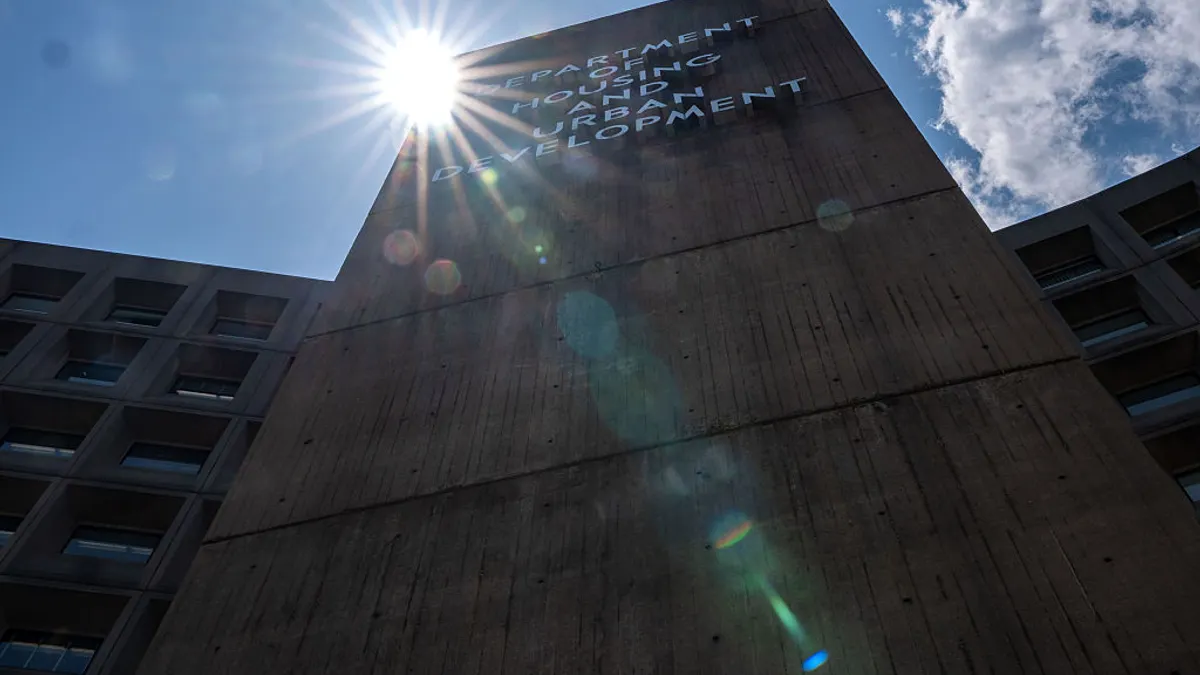
HUD is continuing to tighten rules for tenants and loosen regulations for operators, most recently by moving to allow more rapid evictions, work requirements up to 40 hours per week and term limits for residents in agency-supported housing.
On Friday, HUD proposed a rule to permit public housing agencies to impose work mandates for eligible adults as well as term limits as short as two years for nondisabled tenants ages 18 to 61 living in public housing or using Housing Choice Vouchers, Project-Based Vouchers or Project-Based Rental Assistance. It is open to public comment until May 1. Currently, fewer than 1% of all public housing authorities have work requirements, per HUD.
It follows an announcement earlier in the week that property owners receiving HUD funding no longer have to give tenants a 30-day written notice for nonpayment of rent prior to eviction. The change would allow them to terminate leases in as few as five days, depending on the program and state and local regulations. The measure, released on Feb. 25 with no public comment period, goes into effect on March 30.
The 30-day notice rule originated in the CARES Act in 2020 to help keep people housed during the COVID-19 pandemic, and it was made permanent in 2024. HUD claims that rolling back the measure will strengthen the functioning of its housing assistance programs. More than two million households will be affected by this rule, per HUD.
“This deregulatory action advances HUD’s mission of cutting red tape, promoting local flexibility, and increasing housing affordability by recognizing the case-specific needs that exist across rural, tribal, and urban communities,” HUD Secretary Scott Turner said in a release. HUD said it has also “rescinded 17 COVID-era notices to further reduce regulations and paperwork,” many related to information PHAs must provide tenants.
The rule also goes a step further and removes the ability of the HUD secretary “to prescribe information to be included in the notice to tenants in the event of a Presidential declaration of a national emergency,” per the Federal Register.
HUD proposes work mandates, term limits
According to Turner, allowing public housing providers to impose strict work requirements and term limits across almost all HUD housing programs will “restore dignity and well-being among residents we serve.”
“Housing assistance was never meant to trap work-able individuals on government support their entire lives, rather it should be a temporary foundation to launch into a life of self-sufficiency,” Turner said in a release. “Our proposal expands access for deserving families on waiting lists, while still preserving protections for elderly and disabled households.”
Currently, the agency only serves about a quarter of those eligible and in need of housing support, per HUD. However, HUD has cut its staff by about 30% since the Trump administration retook office, Politico reported in October. Nonetheless, after proposing steep cuts to the agency, the recently passed FY2026 appropriations bill provides $77.3 billion to HUD, a $7.2 billion increase from FY2025, according to the Bipartisan Policy Center, with cuts to public housing and increases to tenant-based rental assistance.
Per the new policy, PHAs can designate who within a household is subject to the work requirements and how to apply them. The owners that implement work mandates or time limits will be required to offer supportive services to assist tenants in fulfilling policy requirements.
Industry reacts to the 30-day notice rollback
Missed rent causes financial instability that impacts small public housing agencies and owners in particular, according to comments recorded in the Federal Register. That loss of income means they could fall short of fulfilling HUD’s mission because they are unable to pay for property maintenance, insurance and staffing.
“While the 30-day notice provided tenants with longer runways to undertake remedial actions to become current with their rent, such as seeking a retroactive income redetermination in the case of job loss or income reduction, the consistent increase of [Tenant Accounts Receivable] suggests many tenants did not avail themselves of such options,” per Register comments.
Many housing industry groups, such as the National Apartment Association, have been pushing Congress for the changes and praised HUD’s latest efforts.
National Affordable Housing Management Association CEO Kris Cook said in the HUD release that the organization and its partners had raised concerns about the impact of the 30-day rule with the Trump administration.
“HUD’s 30-day notification requirement—though well-intentioned—placed significant strain on property owners, often compounding arrearages, preventing normal lease enforcement, and threatening the financial stability of affordable housing communities,” said Cook. “Left unchanged, it risked discouraging private sector participation, raising operating costs, and reducing the supply of affordable housing.”
Public housing agencies and property owners receiving HUD funding will benefit from the streamlined and simplified guidance for nonpayment of rent, according to Sharon Wilson Géno, president of the National Multifamily Housing Council.
“Evictions are a last resort for owners, and this guidance rightly returns this set of laws to the state level where it can be appropriately regulated, providing a clear and unified policy for housing providers,” Wilson Géno said in HUD’s release.
However, tenants’ rights and antipoverty groups warned the rollback would harm residents amid an already-severe affordability crisis and housing shortage. In response, the National Housing Law Project and the Legal Aid Society of Eastern Virginia filed suit against HUD on Monday in the U.S. District Court for the District of Columbia to delay it from going into effect.
“The 30-Day Notice rule gave poor and working families a fair chance to understand what they owe, correct errors, or catch up on rent before facing the devastating consequences of eviction,” Brandon Ballard, strategic litigation attorney for LASEV, said in the release. “Weakening these protections will only increase homelessness, destabilize families, and deepen economic inequality.”
Click here to sign up to receive multifamily and apartment news like this article in your inbox every weekday.