Dive Brief:
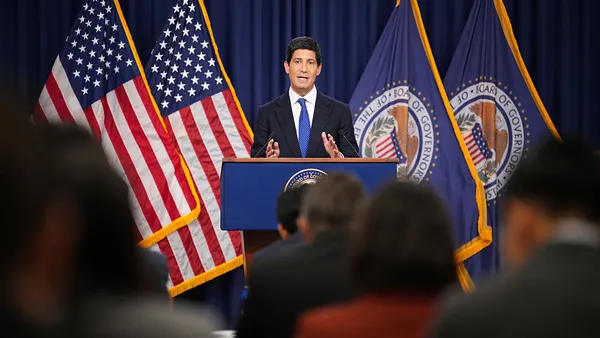
- The Federal Open Market Committee held the federal funds rate steady at 3.5% to 3.75% at its March meeting on Wednesday, as Chair Jerome Powell announced that he was hosting his last press conference in his current role but will stay on as a governor.
- While the Fed noted that “economic activity has been expanding at a solid pace,” job gains remained low and the unemployment rate “has been little changed in recent months.” Inflation has remained elevated, partly reflecting the rise in global energy prices.
- Multifamily observers weren’t surprised by the Fed’s decision to hold rates steady again. “There are just too many uncertainties at this time for the Fed to take any action and as a result, the multifamily market is likely to see little change in its current activity and sentiment,” Talonvest Capital Co-Founding Principal Thomas Sherlock said in emailed comments.
Dive Insight:
After multiple rate cuts last year, this is the third straight meeting in which the Fed has maintained current rates.
Fed Presidents Beth Hammack, Neel Kashkari and Lorie Logan supported maintaining the target range for the federal funds rate but did not support including an easing bias in the statement at this time, while Governor Stephen Miran again favored cutting the federal funds rate by a quarter point, according to the FOMC statement.
Powell commented that inflation has recently risen and is elevated relative to the Fed’s 2% target. “Near-term measures of inflation expectations have risen this year, likely because of a substantial rise in oil prices,” he said.
Tyler Chesser, co-founder and managing partner at Louisville, Kentucky-based CF Capital, said the market has already priced in the Fed’s decision, and pointed to the 10-year Treasury as a bigger driver of multifamily capital costs.
“With sticky inflation around 3% and energy prices elevated from the Iran conflict, the Fed simply doesn't have the cover to cut right now, and Powell isn't going to make a controversial move on his way out the door,” Chesser said in emailed comments.
Ivan Barratt, the founder and CEO of BAM Capital, also expected the Fed to maintain rates, but noted that Federal Reserve Chair nominee Kevin Warsh could take the central bank in a different direction.
“With regime change at the Fed later this year, my current thesis suggests it's a 1940s analog where the Fed will pin rates lower [aka yield curve control] to monetize the debt,” Barratt said.
However, Powell noted at his press conference that the central bank will need to continue evaluating economic risks.
“The economic outlook remains highly uncertain, and the conflict in the Middle East has added to this uncertainty,” Powell said. “In the near term, higher energy prices will push up overall inflation. Beyond that, the scope and duration of potential effects on the economy remain unclear, as does the future course of the conflict itself.”
Click here to sign up to receive multifamily and apartment news like this article in your inbox every weekday.