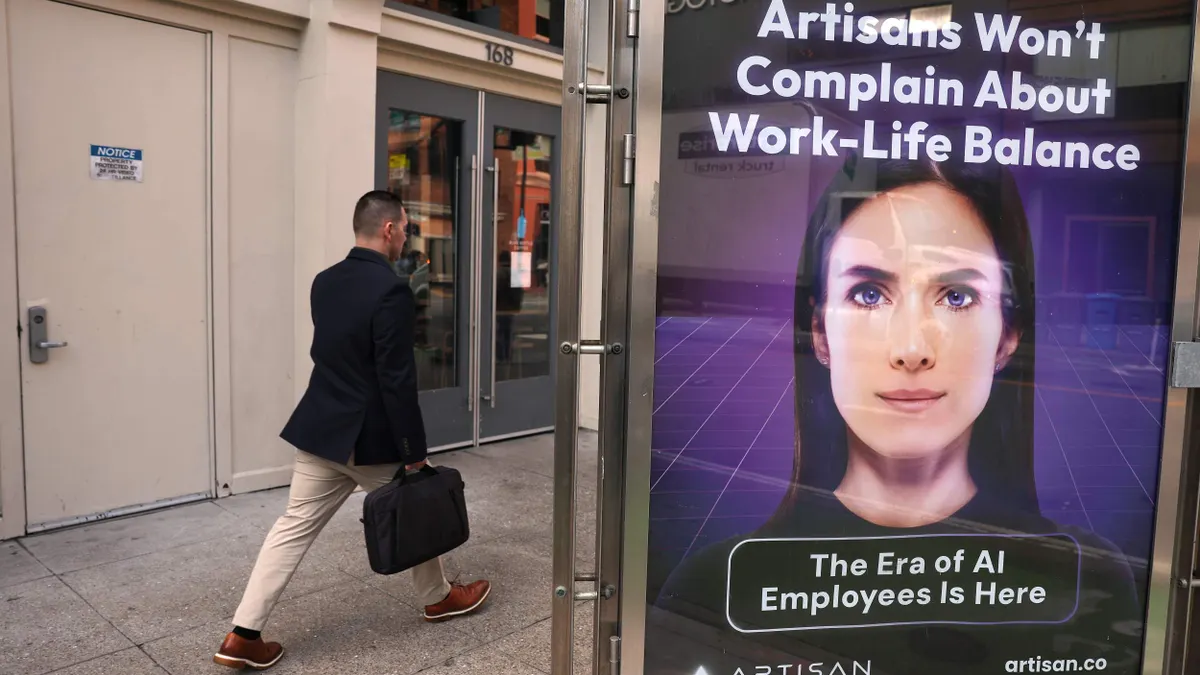
For years now, fears that artificial intelligence will spur widespread job loss have been more theory than reality.
But this year, those warning calls have gotten even louder.
In February, Citrini Research sounded the alarm about a scenario in which rapid adoption of advanced AI could push unemployment to 10% and trigger a 40% decline in stock markets, leading to widespread white-collar layoffs. In the same month, Square and Cash App operator Block announced sweeping layoffs affecting more than 4,000 employees amid AI-driven changes to its business, USA Today reported.
In March, 15,341 job cuts were attributed to AI, making it a top-cited reason for layoffs, according to global outplacement and executive coaching firm Challenger, Gray & Christmas. Since 2023, AI has been pointed to in 99,470 job-cut announcements, accounting for 3.5% of layoff plans. However, some observers are questioning whether it is the sole reason for many of those job cuts, according to The New York Times.
Increasingly, some apartment owners, Wall Street analysts and economists are watching to see whether layoffs related to the technology could weaken demand among younger white-collar renters and, in the process, hurt the tech-heavy and luxury markets that depend on high-income workers.
But some executives still don’t think the multifamily industry is taking the AI threat seriously enough. “If you just said, ‘Listen, 20% or 30% of your tenant base is going away,’ maybe people would pay attention,” said Patrick Carroll, founder of Carroll Holdings. “But I don't think they know enough about AI and how it's going to transform the world, to maybe get their head around it.”
Uncertain job impact
The idea that AI could upend the workforce is no longer viewed as just a theory. It's a real possibility, but there’s still debate about what that would look like and whether there would ultimately be a net loss of jobs.
“Every technological wave will eliminate some jobs and create other jobs, and it's always been the case,” Federal Reserve Chairman pro tempore Jerome Powell said in the central bank’s January press conference.
Ian Bingham, senior vice president of business development at Chicago-based owner and operator Daniel Management Group, compares the fervor about AI replacing humans to the fears five years ago that centralization would claim apartment positions and “affect headcount in a way that we had never seen before.”
Ultimately, Bingham said, the headcount shifted from the properties to offsite locations, with barely any reduction in the number of workers. “They took people from on-site and put them in a regional or a corporate office, changed the job scope, but found that the renter preference and the customer service need still existed,” Bingham said.
Despite some high-profile job cuts attributed to AI adoption and increased efficiency, the signals in the broader labor market are harder to decipher. Carl Whitaker, a chief economist and vice president with RealPage's Data Analytics division, thinks the current employment market is more a product of “broader economic uncertainty” than AI.
“The fear is that layoffs are happening left and right because AI is taking workers' jobs,” Whitaker said. “That doesn't seem to be happening. It's more so just that companies are super, super cautious in their approach to hiring today.”
The younger renter problem
AI might not yet be displacing workers on a wholesale basis. Still, it has been cited as a culprit behind economic problems among younger professionals — an extremely important cohort for rental housing.
“Young adults forming new households make a strong contribution to demand for apartments,” LeaseLock Chief Economist Greg Willett told Multifamily Dive in emailed comments.
Among 16- to 24-year-olds, unemployment was 10.4% at the end of 2025, an increase from 9% in late 2024 and 8% in late 2023, Willett said.
“While it's hard to pinpoint how much of that rising unemployment reflects AI's ability to cover tasks previously done by entry-level workers, shifts in the way we do business do appear to be having some impact on the numbers,” Willett said. “Recent grads are ending up back home with their parents more frequently than was the case a year or two ago.”

Whitaker is also focused on the employment situation for the 25- to 29-year-old cohort. “Primary schools have taught for the past 10 years that if you know how to code, you've got a great job waiting for you,” he said.
But in the future, that might not be the case. In fact, Carroll sees entry-level tech, finance, legal and administrative white-collar jobs disappearing as new technology takes hold. “You usually want those kids coming out of college, who have that high-paying job, to fill up class A apartments,” Carroll said. “And that's just what's going to get hit the hardest [by AI].”
Tech market risk
AI-driven job loss won’t hit the U.S. uniformly. Some markets, mainly tech magnets, seem more susceptible to problems than others. “I think it's more coastal risk than a Sun Belt risk, just given where the AI jobs are concentrated,” said Haendel St. Juste, managing director and senior REITs analyst for investment bank Mizuho Securities.
But in some of those areas, AI has been leading to a jobs boom, at least temporarily. In recent earnings calls, REIT executives said San Francisco consistently ranked as the top market.
In fact, Equity Residential CEO Mark Parrell said that AI is driving apartment demand in San Francisco, citing robust office leasing activity. “It isn't just the actual creators of AI,” he said on the REIT’s first-quarter earnings call in April. “It's all the systems that sit on top of it… So I think there's room to run here.”
But aside from excitement in REITland about downtown San Francisco, there are broader concerns about tech jobs in Northern California. Whitaker cautions that the overall metro-level employment in San Francisco or San Jose isn’t impressive, barely recording positive annual job growth.

“I think we're seeing the impact of having specific tech nodes, particularly in urban cores that don't have a lot of new supply and already have tight vacancy,” Whitaker said. “That's where it creates this environment of much stronger rent growth.”
If coding and software development are potentially casualties of the AI revolution, some apartment executives would rather avoid the tech hubs. “If I have large holdings in Austin or in San Jose, I would probably be a little more nervous,” said Bingham, though he doesn’t see a “mass exodus of tech jobs due to the evolution of AI.”
Ultimately, Carroll sees AI taking jobs in areas outside technology, such as finance, which could expose more metros to job loss. “It’s going to hit New York, San Francisco, Boston — those kids that are working for the big consulting firms and the Goldman Sachs and big investment banks,” he said.
On-the-ground reality
The feared AI jobs apocalypse is certainly plausible. However, right now, operators say reality doesn’t support that narrative, at least in Sun Belt and Midwest markets.
“I have not heard of one resident coming in and saying, ‘My job was lost today [due to AI],’” said Daniel Management’s Bingham, whose firm operates in the Midwest and Texas.
Jackie Impellitier, chief operating officer for ZRS Management, which has a heavy Sun Belt presence, said leasing activity, tour volume and occupancy trends continue to track more closely with traditional drivers such as local job growth and migration patterns, rather than with specific technology-related employment concerns.
“From what we’re seeing across our portfolio today, we have not observed any measurable softness in demand tied specifically to white-collar job loss or concerns around AI-driven displacement,” Impellitier said in emailed comments. “It is certainly something we are watching carefully.”

Carroll, who sold his apartment holdings in December 2023, isn’t just watching for the potential of AI-related job loss. He wants to place bets on product types he thinks are less susceptible to mass white-collar layoffs. When he does come back to the market, he’ll purposely seek class B and B-plus properties in suburban locations.
“You have people who work in health care, trades, police officers and things like that are sticky,” he said. “They're not going to be replaced.”
Others may not yet be repositioning their portfolios into more defensive asset classes and markets, but there is a broader unease about what’s coming.
“It feels like the labor force is in a very precarious moment right now,” Tailwind Investment Group Vice President of Investments Trey Wheeler said.
Click here to sign up to receive multifamily and apartment news like this article in your inbox every weekday.