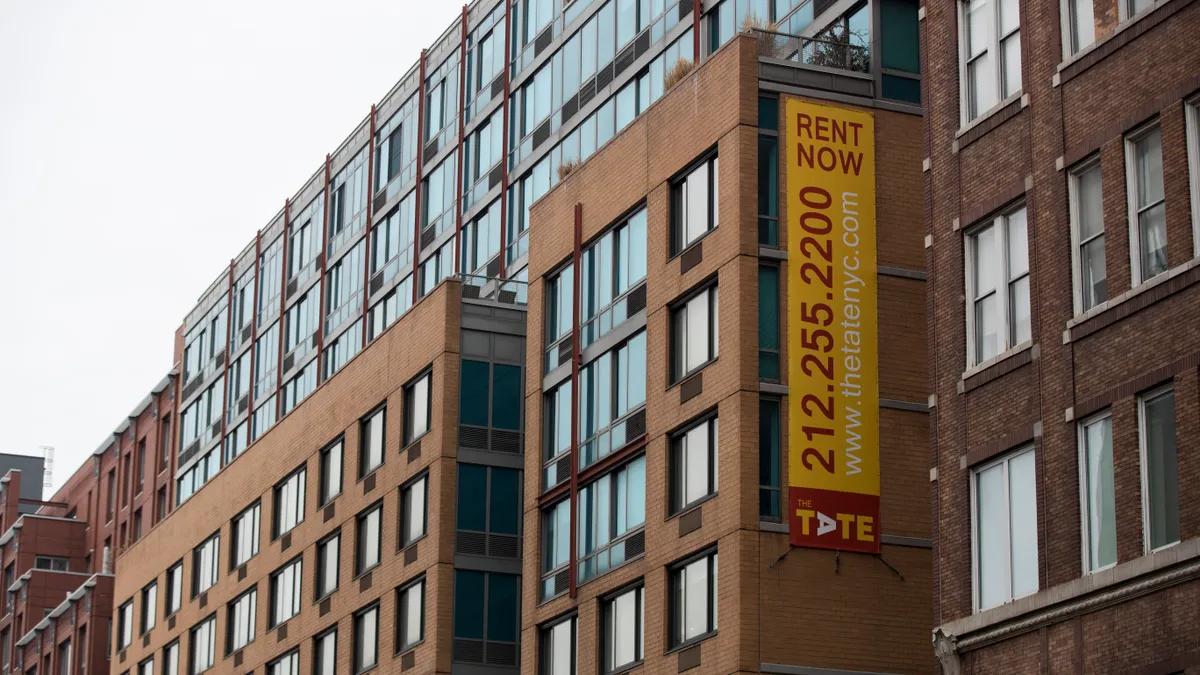
Average U.S. rents fell $8 to $1,740 in November, marking the fourth consecutive month of decline, while year-over-year growth dropped 30 basis points to 0.2%, per a new report from Yardi Matrix. Advertised rents have declined $17 since they peaked during the summer.
Rent growth is now at the lowest level since the first quarter of 2021, when the market was beginning to recover from the pandemic. Lifestyle rents for the month declined 0.5% year over year, while renter-by-necessity prices fell 0.4%.
“This month’s declines were broad-based and somewhat unexpected,” the report’s authors wrote. “The recent drop is less than ideal, but more worrisome is how widespread the decline is.”
Rent growth has been weak for two years in high-supply markets, but over the last three months, advertised rents have been negative in 90% of the top 30 metros. The Twin Cities is the only major metro to produce positive growth during that span.
Even top-performing markets such as Columbus, Ohio; Indianapolis; New Jersey; San Jose, California; and San Francisco saw advertised rents turn from positive to negative. Most sport occupancy rates at or above the national average, so the poor performance cannot be attributed to weak overall conditions, according to Yardi.
The national occupancy rate held steady at 94.7% in October, unchanged from a year ago.
Why rents are slumping
Historically the winter months are weak for rent growth, but over the last few years as rents climbed sharply in the wake of the pandemic, this period has been more volatile, per Yardi.
“Though some winter softening is normal, this year’s drop — after 1.4% November gains in both 2023 and 2024 — signals slowing demand,” according to Yardi.
Rent growth could remain weak due to the supply-demand imbalance, per Yardi. Immigration policy, weak consumer confidence and slowing job growth have caused absorption to decelerate amid a large delivery pipeline.
Regional trends
Northeastern markets such as New York and New Jersey, which have been among the strongest performers on an annual basis, were both in the top five for November declines. Similarly, San Francisco, which had been recovering throughout the year and has benefited from artificial intelligence-related job growth, saw a 0.8% month-over-month drop.
Steep declines in lifestyle rents continue to drive overall market weakness, most clearly in New York, according to Yardi.
On a year-over-year basis, coastal and Midwestern metros recorded the highest rent growth, led by New York (5.7%), Chicago (3.8%), the Twin Cities (3.2%), San Francisco (2.6%) and Kansas City, Missouri (2.2%).
Still, YOY rent growth remains negative in many high-supply metros, led by Austin, Texas (-5.0%); Phoenix and Denver (both -4.1%); Las Vegas (-2.1%); and Dallas (-2.0%).