LAS VEGAS — Each year Dom Beveridge puts together a paper called 20for20, where he talks to apartment executives to figure out what they're working on and what they’ve done over the previous year.
A few years ago, something new started popping up in the responses they were giving the principal at Houston-based consulting and research firm also called 20for20.
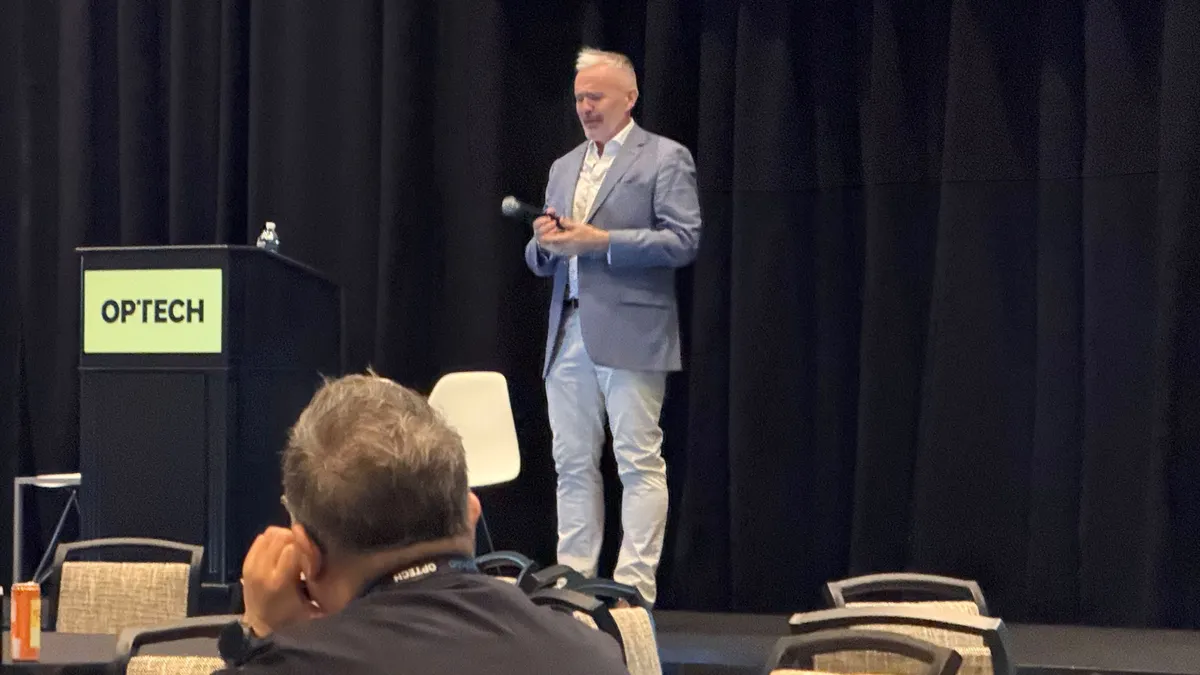
“About three years ago was the first time fraud prevention had just emerged as this big priority that that companies were grappling with,” Beveridge said on Monday at OPTECH 2026 in Las Vegas.
During the COVID-19 pandemic, when online leasing really took off and eviction moratoriums were in effect, fraud grew at apartment communities around the country, especially in spots like Southern California and Atlanta.
“When you make it easier to lease multifamily units, you also make it easier to commit fraud,” Beveridge said. “So the problem of application fraud has pretty much followed the industry's adoption of online leasing-related technologies.”
By some estimates, nearly 25% of apartment applicants this summer were using fraudulent Social Security numbers, according to Austen Mount, managing director of operations at TruAmerica Multifamily.
“When you start to hear some of the background stats, it really is mind blowing just how pervasive fraud has become for us as an industry,” he said at OPTECH.
The good news for operators is that, as companies reduce on-site decision-making, technology vendors have stepped up to deliver products that can help reduce fraud.
Software-led solutions
In response to the growing problem, industry players and vendors have developed tools to better vet prospects. Beveridge said those offerings were adopted faster than other technologies. As that happened, more management firms were also moving administrative tasks offsite.
“As people have gained experience of doing fraud prevention, particularly doing it systematically, the industry has learned a lot of stuff and is changing the way that people are working,” Beveridge said.
Unlike some property management challenges, Beveridge said that vendors initially understood the issue better than operators. “As people adopted the technology, gained experience in using it, they started to understand the problem better.”
However, fraud is only one risk. “In fact, it doesn't even account for most of the risk that causes your bad debt,” Beveridge said.
Beveridge said the companies handling screening poorly are the ones who “just force everybody to do every single check, as if the best applicant is the same as the highest credit risk applicants. And we just push everyone through the same process.”
By doing that, management firms add both time and expense. “It's not a good experience,” Beveridge said. “What you're really, in my view, looking to do is to try and create a fast lane for good guys. You're trying to figure out who the people are that pass all your checks with flying colors. You're trying to get them through the checks as quickly as possible.”
Centralizing the screening process
Management firms have taken various routes to curtail fraud. Western Wealth Communities was originally going to centralize screening with subject matter experts.
“I preferred to have three people who were subject matter experts managing our screening versus the 40 at 40 different locations that we had,” Marlana Murdock, vice president of property performance at Western Wealth Communities, said at OPTECH.
As that was happening, vendors started bringing products to market that made screening easier, prompting Western Wealth Communities to fully automate the process. “We moved our mindset and our centralization plan from centralizing screening to then working with the vendor to fully automate screening,” Murdock said.
The leasing team educates the prospect about the screening process, which is managed by a third party using artificial intelligence. If the applicant is declined, a human can review and potentially override the AI decision.
“That's probably about one in 20 or one in 25 of our applicants that come back … [to] discuss an override of some sort,” Murdock said. “That's when it then goes to a real human like myself to review and make decisions.”
Leasing teams’ motivation to fill units can lead to questionable approvals. By centralizing the process, companies move those decisions away from onsite teams.
“We almost never override for hardly any reasons,” said Jordan Ross, director of strategic initiatives at Highmark Residential, at OPTECH. “We'll reevaluate, but the override almost never happens.”
When overrides do happen, it's often because of an unusual source of income. “It's usually one of those unique situations where someone lives solely off of a trust,” Ross said.
Click here to sign up to receive multifamily and apartment news like this article in your inbox every weekday.