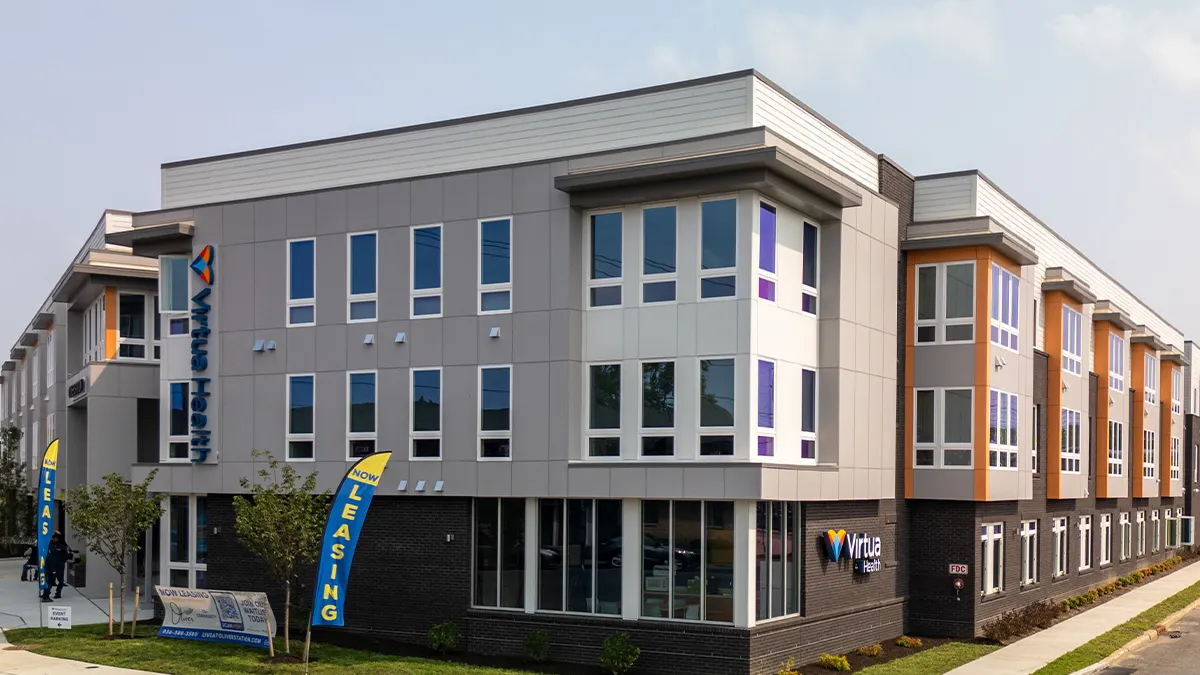
To help meet the country’s affordable housing needs, developer The Michaels Organization is getting creative with its collaborations.
For example, Michaels partnered with Virtua Health on its Oliver Station project in Camden, New Jersey, pairing affordable housing with on-site primary care, and with Disney in Central Florida to build workforce homes. The firm provides a suite of affordable housing services including development, property management, construction, acquisition and investment.

These are great examples of what can be accomplished when commitment exists on both sides of the table, said Jonathan Lubonski, who was recently promoted executive vice president of affordable development of Camden-based Michaels.
“We’re building deeper partnerships with institutions that shape the health and stability of a community,” Lubonski told Multifamily Dive. “Engaging from the start is key for planning and financing.”
Lubonski, who previously served as senior vice president, now oversees all aspects of affordable housing development across Michaels’ extensive national portfolio, guiding both new construction and preservation initiatives at a time when demand for attainable housing is reaching historic highs.
Here, Lubonski talks with Multifamily Dive about his strategy, challenges to affordable housing and keys to success.
This interview has been edited for brevity and clarity.
MULTIFAMILY DIVE: As you step into the EVP role, what strategic priorities or new development initiatives are you most focused on in 2026 and beyond?
JONATHAN LUBONSKI: My focus is on building a national platform that’s faster, more predictable and more strategic. That means bringing development, construction and management together as one engine, concentrating on markets where we perform best and exploring new approaches like mixed-income and attainable housing communities.
Our goal is to deliver high-quality projects efficiently while creating long-term community impact.
The affordable housing landscape is shifting quickly with financing constraints, rising construction costs and demand far outpacing supply. Where do you see the most viable opportunities for new project models or partnerships to close the gap?
The affordable housing environment is more challenging than ever. Our approach is to explore every creative option, from energy-saving programs that reduce operating expenses to innovative portfolio-level financing and, as always, public-private partnerships.
Maintaining strong relationships with lenders and investors is key to placing debt and equity under the best possible terms. We also pursue other opportunities like below-market land, tax abatements, reductions or waivers of permitting fees and access to soft funding.
Michaels has been active in both ground-up development and preservation of existing communities; what financing or community engagement strategies do you believe will be important going forward?
Preservation projects are complex and depend on many factors, such as existing debt, capital needs and the availability of preservation financing under state Qualified Allocation Plans. Advancing preservation deals can be particularly challenging in states where tax credits are highly competitive and demand outweighs supply.
We’ve always maintained a healthy balance between preservation and new construction, and both remain priorities. We have a large portfolio of existing assets, and rehabilitation is critical to meet the needs of residents — reinvesting, modernizing and upgrading properties as they age. Community engagement is essential for both preservation and new construction, but even more so for preservation, since rehabs directly affect existing residents.
Meaningful engagement is at the core of every one of our projects from site selection and design to construction and long-term management. This means maintaining close contact with key stakeholders and ensuring our teams are listening and responding.
With competition for tax credits intensifying nationally, what funding approaches do you see as most promising for getting deals to pencil in today’s environment?
From my perspective, the basics of affordable housing finance are still the same. You need credits, soft funding and strong partners. What is changing is how we put those pieces together.
We’re seeing some private capital interested in affordable housing, some creative bond structures that can lower costs and of course states were given the ability to increase their Low-Income Housing Tax Credit capacity. These things help, but the real work is still the same: realistic underwriting that considers current market factors, most importantly at the moment LIHTC pricing, construction costs and OPEX.
What policy changes do you think would make the biggest impact on accelerating development timelines?
The zoning process is essential for responsible planning and managing growth. But there’s room for improvement.
Specific zoning for affordable housing and statutory timelines for plan reviews and approvals.
Jurisdictions that create one strong point of contact to drive the process are extremely effective. It’s not about cutting corners, it’s about removing friction and delays.