Jonathan Rose Cos. has ambitions to bring more affordable housing to high-opportunity locations around the country.
The mission-based development company has nearly 20,000 affordable and mixed-income units in its growing portfolio that spans small and large cities and metros throughout the U.S. Last month, the New York City-headquartered firm named Brandon Kearse as president and chief investment officer to help foster growth.
Kearse joined Jonathan Rose as an associate director in 2015 and moved up the ranks to different leadership roles that helped scale its multifamily housing portfolio. Now, he leads the firm’s strategy and investment platform, with the goal of advancing its mission of creating environmentally sustainable and socially responsible housing.

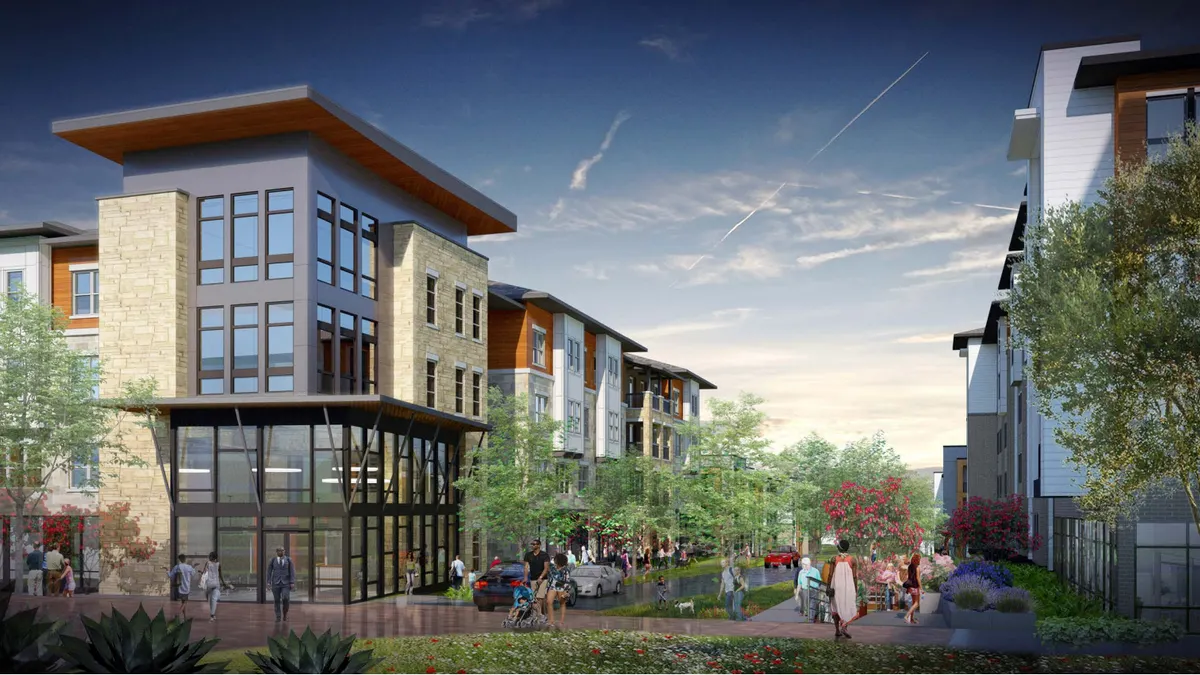
That includes several new-build and affordable preservation projects that are underway. Jonathan Rose is building a new, more-than-500-unit mixed-income and mixed-use building in downtown Athens, Georgia, near the University of Georgia campus. It’s also building what the company touts as the first affordable housing development in New York City’s posh West Village in 20 years: a 176-unit affordable building for seniors.
“We’re excited to do what we’ve always done, which is to provide sustainable, impactful housing in high opportunity places,” said Kearse. “We’re going to keep trying to do that in more places to [reach] more people.”
Here, Kearse talks with Multifamily Dive about the company’s plans for the future, the advantages of taking on affordable housing projects and how to find the right location to build.
This interview has been edited for brevity and clarity.
MULTIFAMILY DIVE: What are your strategic plans for the company under the new role?
BRANDON KEARSE: I think just pushing the envelope every day to do a little bit more, to do it a little bit better than the day before. If we’ve got 20,000 units a day, sometime tomorrow, we’ll have twice that many and that means we’ll have impacted twice as many lives and twice as many communities.
What are some strategies the company uses that allows it to balance construction costs, maintenance, operations and other expenses, while maintaining affordable rental price points?
Right now, with market rates down, market-rate doesn’t actually help you build more affordable. You’re actually, in some places, trying to use the affordable to help build the market-rate. So, I think it depends on the cycle, but one can help the other.
We like to build and preserve affordable housing in high-opportunity areas. And what we find is that, for our residents to have good access to jobs and good access to schools, that’s paramount.
The most impactful thing we can do is choose the locations in which we are investing. And when we invest in those locations, to ensure that existing affordable housing is preserved and those people continue to have access to that opportunity, as the community may be gentrifying around them.
Or if we're building new affordable housing where it hasn't been built in many years, that ensures that those residents have access to everything that those communities can bring, like good schools and good jobs.
What are some unique challenges — and advantages — that developers of affordable multifamily housing face compared to market-rate or luxury multifamily development companies?
The inherent challenge in doing affordable housing is that it costs more to develop than the financing sources available. So filling that gap between what it costs to build a building and what a building can financially support is always the core challenge from a financial perspective.
That necessitates the public-private partnership at a state, local and federal level. And being a good partner to your partners and to your government stakeholders is, I think, unique in affordable housing. It’s not always quite so clear in market-rate housing.
With market-rate housing, you're working in a community with your local zoning laws and land laws and land-use patterns, but you don’t have quite the depth of partnership that you have [with affordable development].
The company has taken on affordable multifamily projects in — to name a few — Athens, Georgia; Beacon, New York; Philadelphia; New York City; San Francisco; and Washington, D.C. The housing market is vastly different in each of these cities. What do you look for when identifying a location to build in?
The number one most important thing for us is in building and preserving affordable housing is high access to opportunity.
For example, we’re building The Beacon [in Beacon, New York]. It will be in the former parking lot of the Metro- North station area. You’ve got a great community in the city of Beacon, but also great transit-oriented access in the form of location next to one of the new rail lines that can take you into the heart of Manhattan in a short amount of time, providing good access to jobs.
It’s access to opportunity and location, number one. If we can be transit-oriented, that's great. Obviously, not all cities have transit available to them. And, good schools and good jobs are a part of that.
The other thing that we look for in building affordable housing or preserving affordable housing is having a true discount to market rent. Generally, what we look for, is to provide low-cost housing in high-cost markets. So it’s very meaningful and impactful, the housing that we are providing.
Where do you see the affordable multifamily housing economy over the next year?
We're very thankful for the strong bipartisan support that was shown this past year — the Low-Income Housing Tax credit, both the 4% version and the 9% version, were expanded by Congress. That’s tremendously helpful in the face of rising costs and ever more demand for limited supply.
Operating costs, interest rates and construction costs continue to remain higher than they have been, so I think we’ve seen state governments and local governments step to the table in really unique ways. We’ve seen more jurisdictions provide property tax relief for more affordable housing projects. We’ve seen different jurisdictions come to the table with state tax credits.
Affordable housing has always been an important issue. But I think it’s getting now, more than ever, the attention that it needs and so we’re getting a lot of support.
Click here to sign up to receive multifamily and apartment news like this article in your inbox every weekday.