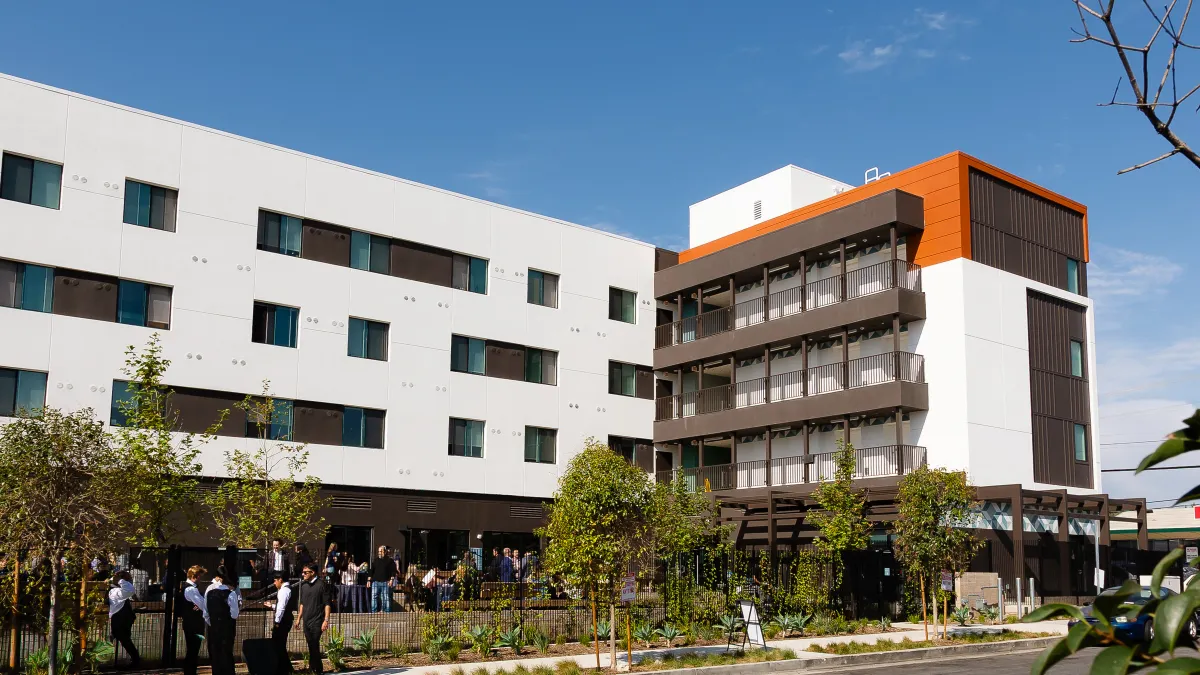
Jacqueline Waggoner recently took the reins at affordable developer Century Housing, a California-focused nonprofit that works to expand housing opportunities through financing tools and long-term community investment. Century Housing said it has created and preserved more than 63,000 homes across the state.
Over her career, the born-and-raised Angeleno has built housing partnerships in California and around the country, most recently as president of the Solutions Division at Enterprise Community Partners. At the time of her appointment in March, Waggoner told Multifamily Dive that her new CEO job is “a perfect alignment of my professional passions and experiences.”
“Stepping into this role at Century feels like a natural continuation of my path and brings together so much of what I care about, from expanding affordable housing to working in partnership with others and leading in a way that keeps people and community at the center,” Waggoner said.
Here, Waggoner talks about policy tools she’s watching, Century’s development approach and challenges to building affordable housing.
This interview has been edited for brevity and clarity.
MULTIFAMILY DIVE: What are some of the biggest challenges right now to building affordable housing?
JACQUELINE WAGGONER: There are significant challenges — not just in California, but across the country. Rising construction costs, including building materials, are making it more difficult to deliver projects at the scale and speed needed to meet the high demand. Insurance costs for affordable housing are also rising dramatically.
In California, climate-impacted areas are seeing significant premium increases, making it harder to afford the preservation of existing affordable homes while keeping their operations running smoothly.
The complexity of affordable housing finance, along with regulatory requirements, also remain major constraints. Many developments rely on multiple layers of funding — public subsidies, tax credits, and private capital — each with its own requirements and timelines. When those sources are delayed or constrained, projects in the pipeline can stall, sometimes for years.
At the same time, the need for new homes remains urgent. California has a verified shortage of nearly one million affordable units. In Los Angeles, over half of renters are rent-burdened — meaning their economic stability is often one missed paycheck away from collapse.
What are some solutions?
Despite the very real challenges, we are absolutely seeing and embracing meaningful solutions and opportunities to strengthen how the system works.
More streamlined processes, along with deeper coordination across public and private partners, can help us build more efficiently in the communities that need affordable housing most. We’re also seeing growing public dialogue — across the industry and at the state level — around challenges like insurance, and how we can better align, pool resources and think creatively about solutions to help stabilize costs over time.

We also know that expanding available funding tools and increasing flexibility in capital will be key to accelerating development and picking up the pace of new development projects. And while cross-sector collaboration — across public, private, and nonprofit sectors — has always been central to this work, there are still opportunities to deepen that coordination: reduce friction, improve delivery and continue to build trust in the system.
Century Housing is navigating these complexities while staying grounded in our mission and our work, but no single organization can solve this crisis alone. We are working closely with partners across the public, private, and nonprofit sectors to strengthen these systems so we can help more Californians access stable, affordable homes.
What housing policies and tools are you keeping an eye on?
We are closely watching policies and other efforts aimed at streamlining housing development without sacrificing quality. We are moving past the era of “business as usual” and focusing on policies that provide both speed and certainty. In a world where time is money, the ability to bypass years of discretionary delays can mean the difference between a family having a home today or five years from now.
Tools, such as housing bonds and tax credits, also remain essential to supporting and continuing production, particularly as costs continue to rise. In addition, we must focus on both production and preservation. Investing in the long-term viability of existing affordable housing is just as important as building new units.
Tell us more about Century’s approach to development.
We are committed to scaling up proven solutions, while always remaining open to new and innovative ones. We are creating space for new approaches that match the scale of today’s need, as we still face a shortage of roughly a million affordable homes across the state.
For us, that means pairing discipline with openness: advancing proven financing and delivery models while exploring innovations, such as modular construction, adaptive reuse and other pathways, that can help us move faster and reach more people.
This work is not about choosing one single path but about flexibility and expanding the solutions available to us.
What else can strengthen affordable housing access?
Many nonprofit and mission-driven property owners are committed to this work and rely on strong partnerships and consistent funding to maintain the homes they operate. At the same time, tenant protections and anti-displacement measures are critical to ensuring residents can remain in stable homes, especially in high-cost markets like California.
Everyone has a role to play in addressing the housing crisis — from developers and public agencies to financial institutions, private investors and communities. Meeting this moment will require coordinated action at scale and a shared commitment to moving faster, more efficiently and more collaboratively.
Click here to sign up to receive multifamily and apartment news like this article in your inbox every weekday.