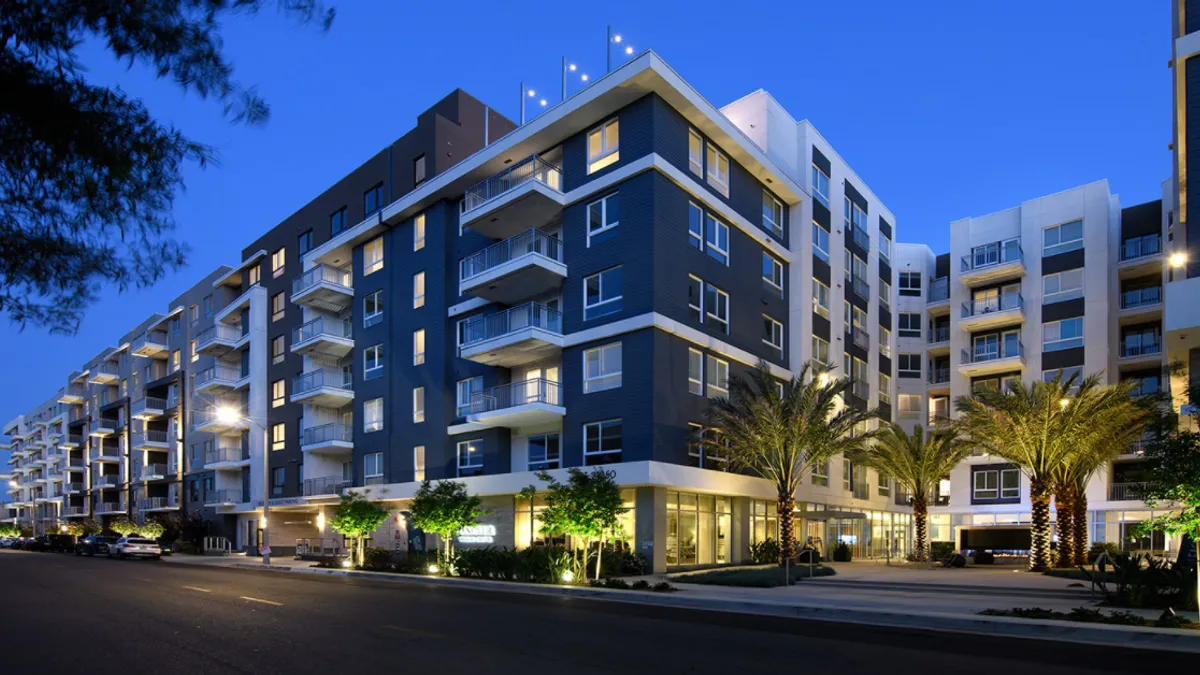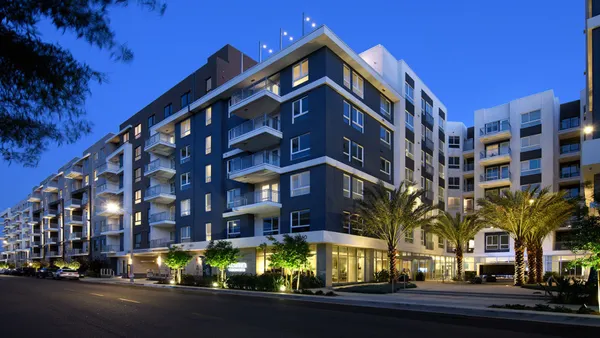
When Camden Property Trust held its earnings call last Friday, analysts came armed with plenty of questions about the REIT’s decision to market its entire California portfolio, consisting of 11 properties totaling 3,600 units.
The Houston-based REIT’s leaders were prepared with answers: They framed the move, first and foremost, as a decision to double down on the Sun Belt, a region ready to grow, after being battered with new apartment supply over the last few years. “When it turns … it's going to turn pretty strong and pretty hard,” said Camden Chairman of the Board and CEO Ric Campo on the REIT’s earnings call last week.
Secondly, it's a good time to sell California, with “lots of buyers” interested, they said. “If you look at the transaction volume across America, the coasts have been the most vibrant transaction environment,” Campo said.
In addition to redeploying capital from the sales into the Sun Belt, Camden also plans to buy its own shares. “We can sell the California portfolio at a cap rate that’s substantially less than our implied cap rate” in Camden stock, Campo said.
Moving out of California should bring Camden some relief on at least one expense line item. Ninety-two percent of the REIT’s political advocacy activity was in California. “Once we close that portfolio, the political advocacy in the Sun Belt will be pretty much zero,” Campo said.
While Camden’s California sale was a big topic in its Q4 earnings call, its 2026 outlook also played an important role, along with an update on its performance in key markets.
Uncertain economy, but green shoots in 2026
For the full-year 2025, Camden’s same-property revenue rose year over year, according to Camden Executive Vice Chairman of the Board Keith Oden on the earnings call. “Our operations teams are celebrating like they just won the Super Bowl,” he said.
Echoing the thoughts of other REITs, Oden expects the situation to improve in 2026 as new apartments are absorbed.
“On the supply front, it is clear that deliveries in almost all of our markets peaked during 2024 and continued to decline in 2025, setting up 2026 and 2027 to be below-average years for new supply,” he said.
Completions as a percentage of supply peaked in Camden’s portfolio at nearly 4% in 2024. They’re expected to be less than 2% this year and roughly 1.5% in 2027, he said.
As the year progresses, Oden said operating conditions should improve with “modest acceleration in the second half of 2026.” The midpoint of Camden’s same-property revenue guidance range is 75 basis points, which is roughly what it achieved in 2025.
BY THE NUMBERS
| Category | Q4 | YOY Change |
| Property revenue | $362 million | 0.5% |
| Net operating income | $235.8 million | 0.0% |
| Operating expenses | $126.2 million | 1.5% |
| Core funds from operations | $1.70 | 1.7% |
| Occupancy rate | 95.2% | -10 bps |
SOURCE: Camden
Like Campo, Oden acknowledged that economic uncertainty will be a key theme for 2026. “We are certain also that whatever jobs are created this year will predominantly be in Camden’s Sun Belt markets, which continue to attract corporate relocations and growth as a result of their affordable, business-friendly environments,” he said.
Oden pointed out that interest rates have doubled over the past few years, which has weighed on consumers’ psyches. However, rental owners have benefited from that trend. “The attainability of a single-family home today is so expensive relative to what it was pre-COVID,” he said.
Market dynamics
Half of Camden’s markets should post 1% to 2% YOY revenue growth in 2026, while the others should sit between 1% and 2% revenue growth, according to Oden. Austin, Texas, with heavy supply, and Denver, with recent regulatory changes affecting income from utility rebilling, will be outliers with slight declines.
In Q4, Austin, Phoenix and Charlotte, North Carolina, posted the sharpest YOY revenue declines for Camden at -3%, -1.4% and -0.9%, respectively. Phoenix faces elevated supply, limiting pricing power through most of 2026, while Austin faces similar issues, according to Oden.
“New supply is finally slowing, and there is light on the horizon [in Austin],” Oden said. “But given the overwhelming amount of new apartment homes delivered in 2024 and 2025, it will take a little while longer for market-wide occupancy to improve and concessions to burn off.”
Oden pointed to Atlanta, Dallas, Southeast Florida and Nashville, Tennessee, as markets expected to improve in 2026 as supply is absorbed. It has budgeted 1% and 2% YOY revenue growth for each of these areas. Camden expects between 0% and 1% revenue growth in Orlando, Florida, and Charlotte and Raleigh in North Carolina.
“Demand has been solid in all of these markets, but it will take a few more quarters to see any meaningful improvements given the higher-than-average supply delivered, particularly in the two North Carolina markets,” Oden said.
In Q4, Los Angeles and Orange County in California, the Washington, D.C., metro area and San Diego and the Inland Empire in California paced Camden in YOY revenue growth at 5.1%, 2.6% and 1.9%, respectively.
“Like D.C. Metro, Southern California outperformed our original expectations, posting mid-3% revenue growth in 2025, in large part due to declining levels of bad debt,” Oden said. “Supply has not really been an issue in most of our California markets, but we do expect less of a tailwind from reducing bad debt as we move through 2026.”
Click here to sign up to receive multifamily and apartment news like this article in your inbox every weekday.