Adam America Real Estate started its first project in the depths of the Great Recession in 2009.
Despite the inopportune time to start constructing housing, the New York City-based firm carved out a niche building apartments and condominiums over its first decade.
However, roughly a decade later, it shifted into a new sector: student housing. “We've been really leaning into student over the last five years,” CEO David Brickman told Multifamily Dive. “It was historically a more traditional multifamily. We’ve just looked at student as a subset of multifamily.”
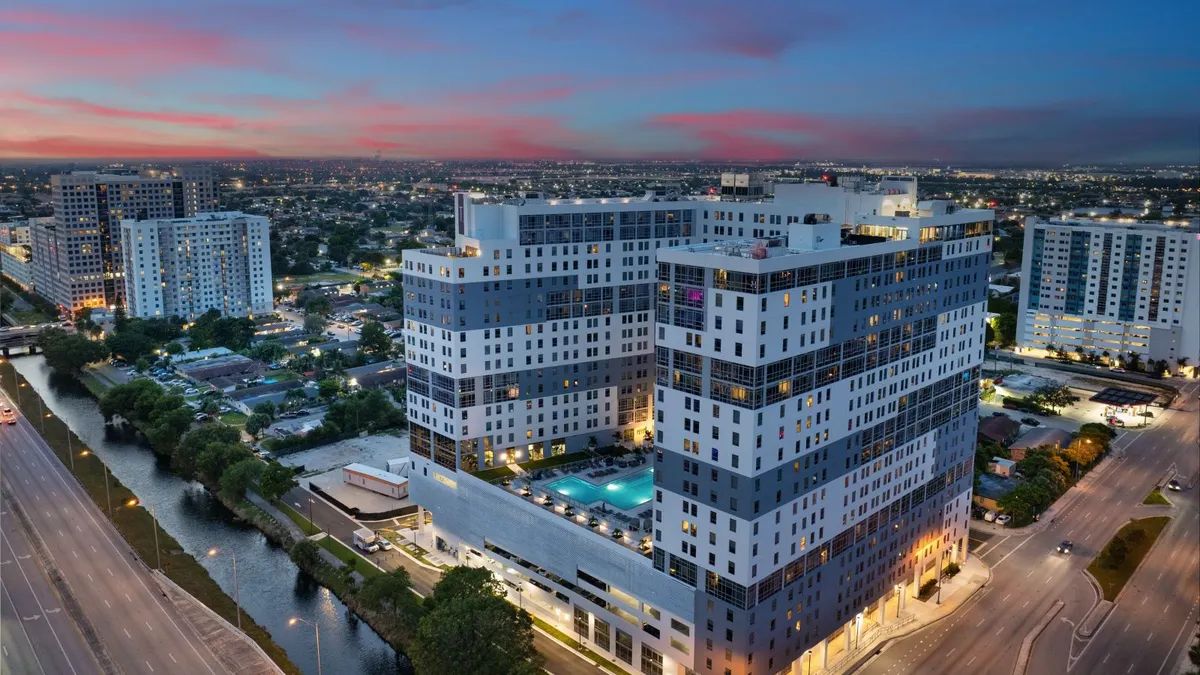
In that time, Adam America has completed the 1,200-bed project Terrazul in Sweetwater, Florida, for Florida International University students; the 690-bed The Hudson & Hudson Suites in Albany, New York, for University at Albany’s students; and the 299-unit, 557-bed Olive & Wooster in New Haven, Connecticut.
The Olive & Wooster project serving Yale University has 172 fully furnished beds designed with students in mind and was the firm’s first student project, according to a press release shared with Multifamily Dive. In addition, Adam America is planning a 30-story student housing tower with more than 1,000 beds in West Campus, Austin, near the University of Texas at Austin.
In a time when turnover is low in traditional apartments, Brickman said student housing gives Adam America a boost.
“We're not getting as many move-ins and move-outs, and that's been challenging,” Brickman said. “On the student side, you have this built-in turnover. Yes, you have renewals. But every year you're getting new students. That has driven some rent growth in a time where it's been more challenging in the conventional portfolio.”
Here, Brickman talks with Multifamily Dive about choosing the right universities, financing student projects and the amenities arms race.
This interview has been edited for brevity and clarity.
MULTIFAMILY DIVE: How does student fit into your portfolio?
DAVID BRICKMAN: We see student housing as part of our continued evolution in the living sector toward more specialized housing categories. We have conventional multifamily, we're building build-to-rent and we’re building student. We're trying to build across the broader living sector in areas with captive demand drivers.
So it just makes sense for us to have student in our broader living portfolio. But the trend that we're seeing in student is definitely a winners and losers from an investment perspective at certain universities. We do believe that the top universities from an investment perspective — the ones with limited supply opportunities — are going to be even stronger, frankly, than they were.
The large millennial generation is well past college age. How have you adjusted to a smaller cohort coming into college?
We're definitely being more selective around schools. In student housing, just like in multifamily, supply and demand drive our business plan. So what will drive demand for student housing?
Obviously, it’s demand for the school and its enrollment growth at the school. You have to have both of those things, and we're being very, very selective. Yes, more broadly, the college-age demographic across the country is predicted to diminish, which is why we're being more selective.
How are you doing that?
We're making strategic decisions on which schools will actually benefit in which states. So, it's not all states where the college-age kid population is predicted to decline. In fact, in some states it's predicted to rise. So we're focusing on those states.
It's about understanding supply and demand. We believe there are going to be some schools that are going to benefit even more, and we believe there are certain schools in certain states that we're likely going to pass on.
Are you seeking larger schools?
We're definitely focusing on flagship state universities for a lot of the reasons that other investors are focused on those. We're obviously following application growth at universities, but it's not simply application growth. We have to really dig into the university's future plans for growth and where they think enrollment is growing. So there are a lot of variables going into where we choose to be.
Is it easier to finance student projects than multifamily construction?
I think it is. Obviously the economics and yields have to work, but there are specific strategies around student with specific student-focused capital. It's got to be at the right university in the right location, with the proximity to campus and with the sponsorship team.

On the equity side, we believe there is targeted capital. There's definitely liquidity on the debt side for both student and conventional multifamily.
We believe there is an element in student that is not really correlated to U.S. GDP growth. The success of your student deal is not contingent on U.S. GDP growth, and so that lack of correlation feels really good right now.
Has there been a truce in the amenity arms race at top schools?
The answer is that it depends. There is still an amenity arms race among the top assets within the market that are chasing the top rents. Those amenities exist at those assets, so anyone bringing in a new product hoping to compete with that has to compete on the amenity side.
But at the same time, location matters just as much as it's ever has and perhaps even more. At some point, just like with college, affordability is king. If you're able to offer good quality student housing at a great location, and at potentially a discount, there are definitely students that are willing to pass up the top amenities for the right price. So it's a balance, and it really depends on the type of product, which university and what students are expecting.
Click here to sign up to receive multifamily and apartment news like this article in your inbox every weekday.